Industry Spotlight - Health Care & Social Assistance in Australia
The quick answer
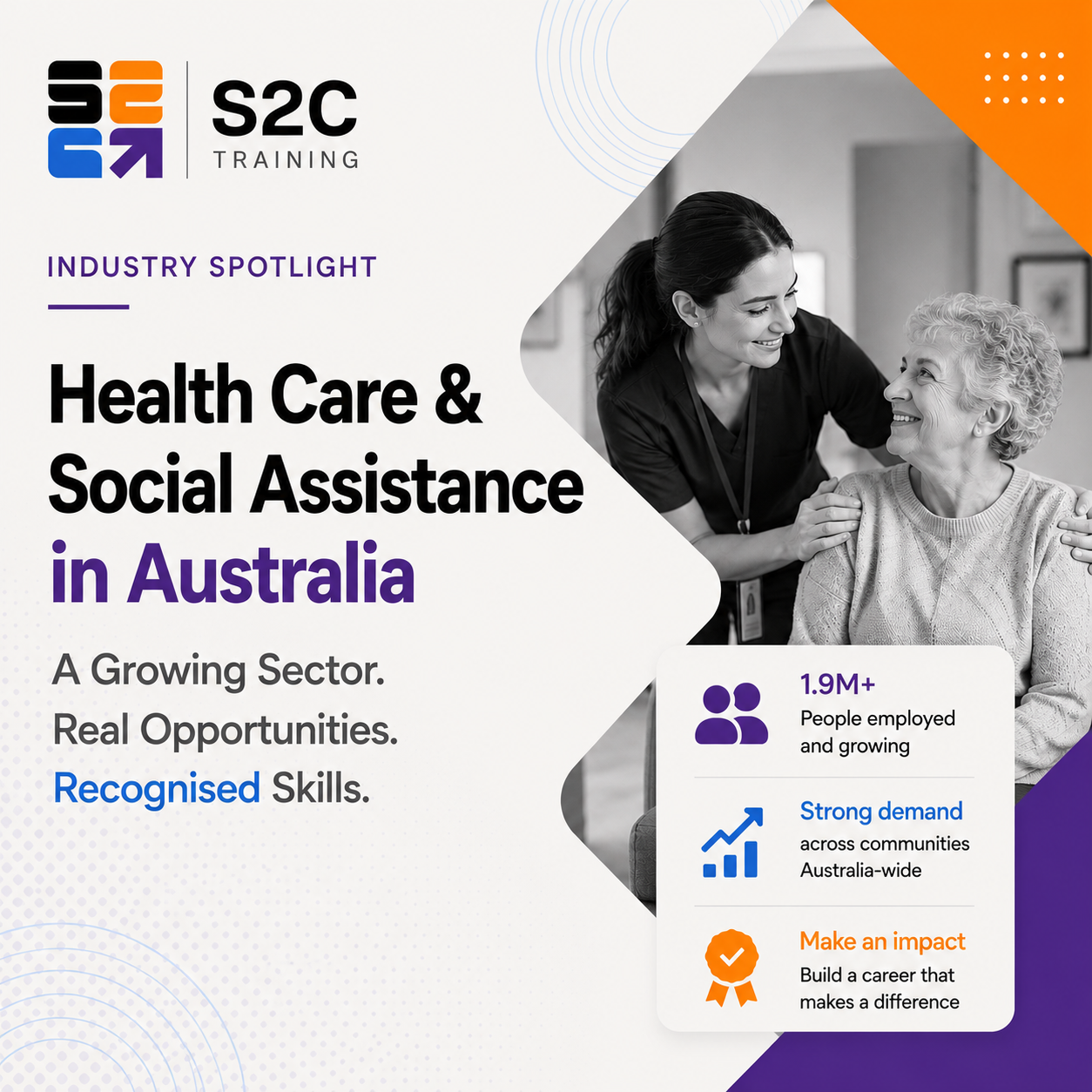
Health Care and Social Assistance is Australia's largest employing industry and its fastest-growing. It provides the main job for around 2.36 million people, about 16.1% of the entire workforce (JSA / ABS, to May 2025), and Jobs and Skills Australia projects it will add more jobs than any other industry over the decade to 2035. For anyone weighing up a career start, a change of direction, or formalising experience they already have, it is one of the safest long-term bets in the Australian economy.
Workforce size: ~2.36 million people (largest of any industry)
Share of all Australian jobs: ~16.1%
Recent growth: +115,200 workers in a single year (+5.1%)
Outlook: Largest contributor to national job growth to 2035
Who it suits: New starters, career changers, and experienced workers formalising skills
How big is the health care industry in Australia?
It is the biggest employer in the country. Health Care and Social Assistance is the main job for around 2.36 million Australians, roughly 16.1% of all workers (JSA industry profile, ABS Labour Force data to May 2025). No other industry employs more people. The workforce is about 75% female, the median age is 40, and around 43% of workers are part-time, which makes it one of the more flexible industries to enter or move within.
The industry is far broader than hospitals. It spans general and specialist medical services, pathology and diagnostic imaging, dental and allied health, ambulance services, child care, and aged and residential care. Its largest sectors by employment are Hospitals (around 616,600 workers), followed by other social assistance services, allied health, residential care and medical services (JSA, to May 2025). That breadth matters: it means the industry has roles for clinicians and non-clinicians alike, including a large administrative and coordination workforce that keeps services running.
How fast is it growing, and what is the jobs outlook to 2035?
The growth is both large and sustained. Across the whole economy, Jobs and Skills Australia projects total employment to rise by nearly 2 million jobs (around 13%), reaching 16.6 million employed people by May 2035 (JSA employment projections). Health Care and Social Assistance is the single biggest driver of that growth. Together with Professional Services and Education, it is projected to account for more than half of all new jobs over the decade.
Within the industry, some occupations are growing especially fast. JSA projects strong growth for nursing support and personal care workers, dental assistants, and ambulance officers and paramedics, among the fastest-growing occupations nationally (JSA employment projections by occupation). Aged and disability carers are projected to be among the highest-growth occupations in the entire country over the next decade.
This is not a short-term spike. Much of the demand is structural, driven by an ageing population that will need more health and aged-care services for decades. Health Care and Social Assistance is projected to remain the largest employing industry in almost every state and territory through the projection period (JSA, state and territory outlook), which means the opportunities are national, not confined to the big cities.
Why is the industry growing, and where is the investment going?
The core driver is demographic. Australia's population is ageing, and demand for care rises sharply with age. The Committee for Economic Development of Australia estimates the country will need at least 400,000 additional aged-care workers by 2050 to meet demand, and around 17,000 more direct care workers every year over the next decade just to meet basic standards (CEDA, Duty of Care). The number of Australians needing some form of aged care is projected to rise from around 1.5 million now to roughly 2.5 million by 2050.
That demand is pulling in significant policy attention and funding. Recent aged-care reforms have introduced stronger workforce standards, and Fair Work Commission decisions in 2024 and 2025 delivered notable pay rises for aged-care workers, improving the appeal of the sector as a career. Industry and government bodies are actively calling for expanded training pipelines, traineeships and clearer career pathways to close the gap. Ageing Australia and other peak bodies describe building a well-trained domestic workforce as essential rather than optional (Ageing Australia workforce strategy).
Is health care a good industry to get into?
For most people weighing job security, meaning and mobility, yes. A few reasons stand out:
• Job security. It is the largest and fastest-growing industry, with demand underpinned by long-term demographic change rather than economic cycles.
• Entry points at every level. From entry-level support and administration roles through to advanced clinical and management careers, there are genuine ways in for new starters and career changers.
• Flexibility. With around 43% of the workforce part-time, the industry suits people balancing study, family or a transition from another career.
• Meaningful work. Surveys of care workers consistently find high job satisfaction and a strong sense of purpose, even where the work is demanding.
• Geographic reach. Because it remains the largest employer in almost every state and territory, skills travel well across the country, including in regional areas where shortages are most acute.
It is also honest to name the challenges: parts of the sector, particularly aged and home care, face workload pressure, and some frontline roles are lower-paid than comparable jobs in other industries, though recent pay decisions are narrowing that gap. Going in with clear eyes, and with a recognised qualification, helps you target the roles and settings that suit you.
A day in the life: what the work actually looks like
Because the industry is so broad, there is no single 'typical' day. But three snapshots show the range of roles, including the large non-clinical workforce that keeps services running.
The health administrator / practice coordinator
In a busy general practice or allied-health clinic, the administrator is the operational backbone. A typical day moves between managing the appointment schedule, coordinating referrals and results, handling billing and claiming, maintaining patient records and privacy, and being the calm first point of contact for patients. When this role runs well, clinicians can focus on care and the whole practice runs smoothly. It is a career in its own right, with clear progression into practice management.
The aged-care or personal-care worker
Whether in a residential facility or providing in-home support, personal-care workers deliver the day-to-day assistance and companionship that older Australians rely on: help with daily living, monitoring wellbeing, and maintaining dignity and connection. It is physically and emotionally demanding work, but consistently rated as deeply meaningful, and it is one of the clearest growth areas in the entire economy.
The registered nurse
Registered Nurses are the largest single occupation in the industry. A shift blends clinical assessment, medication and care planning, coordination across a care team, and communication with patients and families. Increasingly the role also involves digital tools, from electronic records to telehealth. Nursing offers strong mobility across settings, hospitals, aged care, community health and specialties.
Starting out or changing careers: how to get in
One of the industry's strengths is that it has real entry points for people without a health background. Administrative, coordination and support roles are a common way in, and they are in genuine demand because every clinical service depends on them. For career changers, especially those coming from customer service, administration, defence, emergency services or any coordination-heavy role, the transferable skills are substantial.
The data backs the training-first approach: JSA notes that the large majority of new jobs this decade will require a post-secondary qualification, with vocational education and training (VET) qualifications underpinning a significant share of them. In a regulated, safety-conscious industry, a recognised qualification is often what turns experience or interest into an actual job offer.
Upskilling, training and professional development
Health care is a career with a ladder, not a ceiling. Professional development is built into the sector, and pathways typically run from entry-level certificates into diplomas and specialised or management qualifications. For the non-clinical side of the industry, that can mean moving from a health-administration role into practice management, or from a coordinator role into team leadership and operational management.
For people already working in or around health settings, Recognition of Prior Learning (RPL) is often the fastest route to a formal qualification. Instead of repeating what you already do, an assessor reviews evidence of your real work and credits it towards the qualification. It is particularly well suited to experienced administrators, coordinators and support staff whose capability has outgrown their job title.
Where S2C Training fits: qualifications for the health workforce
S2C Training is a Registered Training Organisation (RTO 45605) that specialises in turning real experience into nationally recognised qualifications. In the health context, the focus is on the administrative, business and leadership roles the industry depends on, delivered through a blended model of online learning and workplace-based assessment, and assessed by qualified trainers and assessors.
• Certificate IV in Health Administration - for medical receptionists, records and scheduling staff, and admin coordinators formalising or stepping up in a health setting.
• Certificate IV in Business - for those building broader business and administration capability that applies across health services.
• Certificate IV in Leadership and Management - for team leaders and coordinators moving into supervisory and management roles within health and care organisations.
Each can often be completed via RPL for those with relevant experience. The result is a credential that matches the work you already do, and positions you for the roles this growing industry most needs to fill.
From reception desk to practice coordinator
"Alex" worked for years as a medical receptionist, quietly running the practice's scheduling, records and billing without a formal qualification. As the practice grew, so did Alex's responsibilities, but job applications for coordinator roles kept asking for a credential. Through S2C's Certificate IV in Health Administration via RPL, Alex submitted de-identified examples of the workflows and correspondence already managed day to day. Within weeks, years of experience became a nationally recognised qualification, and Alex stepped into a practice coordinator role in an industry that is only going to need more people like them.
Where to from here
Health Care and Social Assistance is the largest, fastest-growing and most future-proof industry in Australia, and much of its demand is for the administrative, coordination and leadership roles that keep services running. If you already have relevant experience, or you are looking for a meaningful way in, the fastest route is often to get your skills formally recognised.
Complete a free skills check with S2C Training to see how your experience maps to a nationally recognised qualification in this growing industry.
Frequently asked questions
What is the largest employing industry in Australia?
Health Care and Social Assistance is Australia's largest employing industry. It is the main job for around 2.36 million people, roughly 16.1% of the total workforce, according to Jobs and Skills Australia and ABS Labour Force data to May 2025.
Is health care a growing industry in Australia?
Yes. It is projected to be the single largest contributor to Australian employment growth over the decade to 2035, as part of a national increase of nearly 2 million jobs forecast by Jobs and Skills Australia. Aged and disability carers are projected to be among the fastest-growing occupations in the country.
What qualifications do you need to work in health care in Australia?
It depends on the role. Clinical roles such as nursing require specific tertiary qualifications and registration. But many roles, particularly in health administration, coordination and support, are accessible through vocational qualifications such as a Certificate IV in Health Administration, and experienced workers can often gain these via Recognition of Prior Learning.
Can I get into health care without a health background?
Yes. Administrative, coordination and support roles are a common entry point and are in strong demand because every clinical service relies on them. Transferable skills from customer service, administration, defence or emergency services translate well, and a recognised qualification helps convert that experience into a job.
Why is there an aged-care worker shortage in Australia?
Australia's population is ageing faster than the care workforce is growing. The Committee for Economic Development of Australia estimates the country will need at least 400,000 additional aged-care workers by 2050, and around 17,000 more direct care workers each year this decade, driven by rising numbers of older Australians needing care.
What is Recognition of Prior Learning (RPL) in health administration?
RPL is an assessment process that credits the skills and knowledge you have already gained through work or experience towards a nationally recognised qualification. For experienced health-administration staff, it can mean formalising your capability without repeating training you effectively already know.
Sources
• JSA - Health Care and Social Assistance industry profile: https://www.jobsandskills.gov.au/data/occupation-and-industry-profiles/industries/health-care-and-social-assistance
• JSA - Future workforce needs and growing sectors: https://www.jobsandskills.gov.au/news/future-workforce-needs-and-growing-sectors-australia
• JSA - Employment projections (to May 2035): https://www.jobsandskills.gov.au/data/employment-projections
• JSA - Employment projections by occupation: https://www.jobsandskills.gov.au/data/employment-projections/occupation
• JSA - Outlook by state and territory: https://www.jobsandskills.gov.au/data/employment-projections/states-territories
• CEDA - Duty of Care (aged-care workforce): https://www.ceda.com.au/research-and-policy/research/health-ageing/duty-of-care-how-to-fix-the-aged-care-worker-shortage
• Ageing Australia - Workforce strategy: https://ageingaustralia.asn.au/advocacy/workforce-strategy/
More to explore
Keep reading to find insights that matter to your growth

Start your Qualification Journey Today. Obligation Free.
No guesswork. A clear, supported pathway to recognising your experience - with training only where it's needed.
.png)