Industry Spotlight - Professional Services in Australia
The quick answer
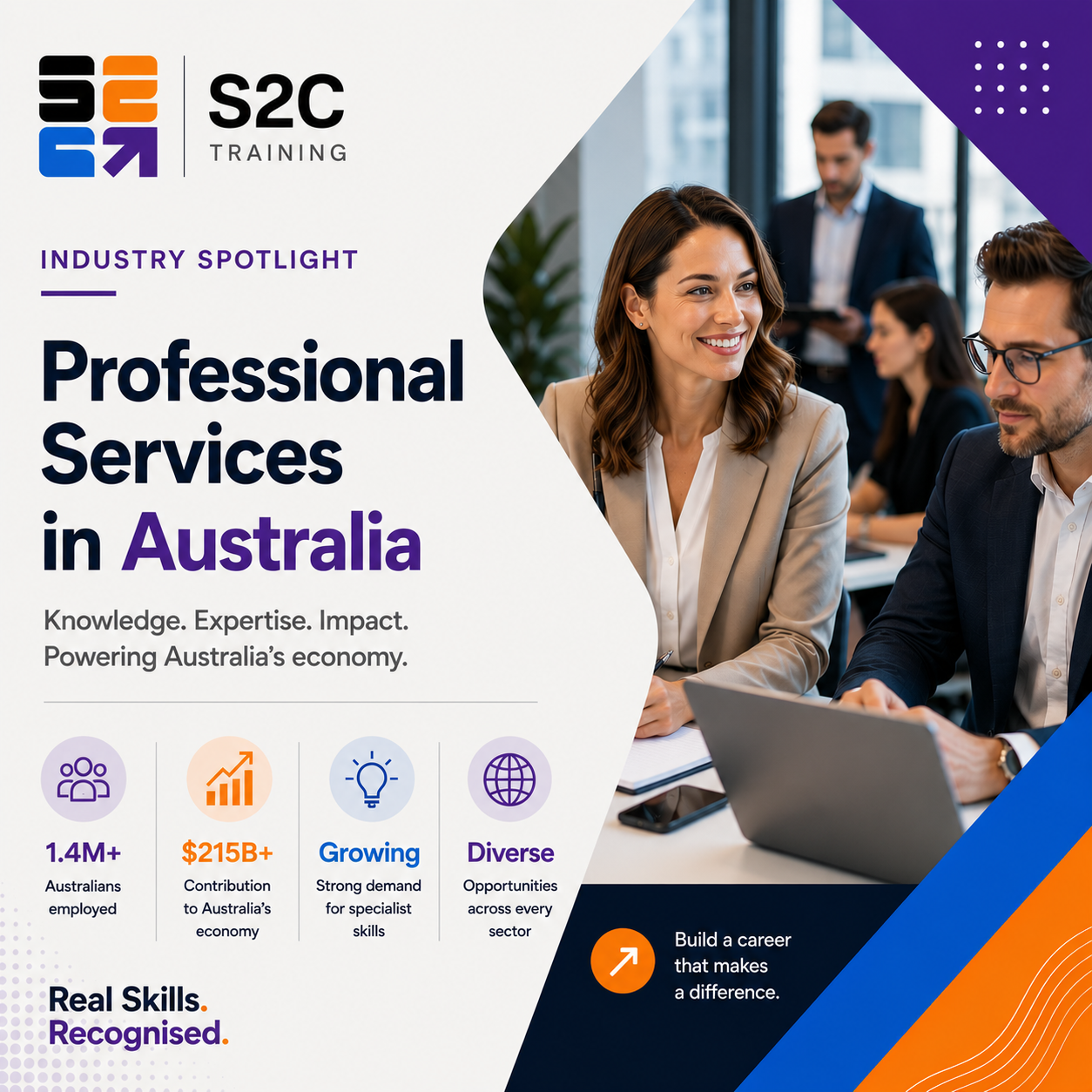
Professional, Scientific and Technical Services is one of Australia's largest, highest-paid and fastest-growing industries. It is the main job for around 1.38 million people, about 9.3% of the workforce, with the highest median pay of any big employing industry at $2,071 per week (JSA / ABS, to early 2026). Alongside Health Care and Education, it is projected to drive more than half of all national employment growth this decade. It is an industry built on expertise, and one where the people who can lead teams, run projects and manage the business rise fastest, which is exactly where a recognised leadership or business qualification earns its keep.
Workforce size: 1.38 million people
Share of all Australian jobs: 9.3%
Median full-time earnings: $2,071 per week (highest of the big industries)
Outlook: A top-three driver of national job growth to 2035
Where S2C fits: Leadership, business and project roles that run these firms
How big is the professional services industry in Australia?
It is one of the country's largest employers and, by pay, its most lucrative major industry. Professional, Scientific and Technical Services is the main job for around 1.38 million people, roughly 9.3% of all workers, with median full-time earnings of $2,071 per week, well above the all-industries median of $1,741 (JSA industry profile, ABS data to early 2026). The median age is 40, the workforce is around 44% female, and only about 20% work part-time.
Businesses in this industry sell expertise as a service. Its largest sectors are Computer System Design (around 360,600 workers), Architectural and Engineering Services, Legal and Accounting Services, and Management and Related Consulting (JSA, to early 2026). The largest single occupation is Accountants, followed by solicitors, ICT professionals, engineers, and advertising and marketing professionals. Behind those specialists sits an essential layer of business managers, project managers, team leaders and operations staff who keep firms running, and it is that layer, plus the leadership above it, that offers the widest entry and progression.
What is the jobs outlook to 2035?
The outlook is among the strongest in the economy. Jobs and Skills Australia names Professional, Scientific and Technical Services as one of three service industries, with Health Care and Education, projected to account for more than half of all national employment growth over the decade (JSA, Future workforce needs). Across the whole economy, total employment is projected to grow by nearly 2 million people (around 13%) over the decade to May 2035 (JSA employment projections).
The growth is concentrated in higher-skilled work. JSA projects the Professionals occupation group to grow by around 845,300 people (21.4%) over the decade to 2035, and Managers to keep rising as a share of the workforce (JSA occupation projections). In other words, this is an industry that increasingly needs skilled professionals and the leaders and managers to run them.
Why is the industry growing?
Three forces are behind it. First, the structural shift of the Australian economy towards services: JSA reports that service industries have driven nearly 90% of all employment growth over the past decade (JSA, Jobs and Skills Report 2025). Second, digital transformation, computer system design is already the industry's biggest sector, and demand for technology, data and consulting expertise keeps climbing. Third, complexity: as regulation, compliance, sustainability and technology reshape how businesses operate, they lean ever more on professional advisers, consultants and project specialists.
JSA also notes that generative AI is, so far, augmenting rather than replacing work, lifting demand for both digital literacy and 'human' skills such as leadership, communication and judgement (JSA, Jobs and Skills Report 2025). Those human, leadership-oriented skills are precisely the ones that don't go out of date.
Is professional services a good industry to build a career in?
For people who want well-paid, intellectually engaging work with a clear path upward, it is one of the best. A few reasons stand out:
• The highest pay of any big industry. Median full-time earnings sit well above the national median.
• Strong, sustained growth. It is a top-three driver of national job growth, underpinned by the economy's shift to services.
• A genuine ladder to the top. These firms are led by managers and executives; capable people who build leadership and business skills can rise a long way.
• Room beyond the specialists. You don't have to be an accountant or engineer to build a career here, the business, project and leadership roles are essential and in demand.
• Future-resilient skills. As AI augments technical work, leadership, judgement and people skills become more valuable, not less.
The honest note: the specialist technical roles (accounting, law, engineering, IT architecture) are largely degree-gated. But the path into leadership and management of these firms is open to capable people from many backgrounds, and that is where formal leadership and business qualifications make the difference.
A day in the life: the people who run professional-services firms
Behind every professional-services firm is a team that leads people, wins and delivers work, and keeps the business running. Three snapshots show the roles S2C's qualifications speak to directly.
The team leader / practice manager
Whether it's an accounting practice, an engineering consultancy or an agency, someone has to lead the team: setting priorities, developing people, managing performance and keeping delivery on track. This is the first real rung of leadership, and it's where informal 'senior person on the team' responsibility becomes a recognised management role.
The project manager
Professional services runs on projects, client engagements, consulting assignments, technical deliverables. The project manager owns scope, budget, timeline, risk and stakeholders, turning expertise into delivered outcomes. As firms take on larger and more complex work, capable project managers are among the most sought-after, and best-paid, non-specialist roles.
The senior leader / director
At the top sit the senior managers, principals and directors who set strategy, drive growth, and lead the organisation. They are responsible for the firm's direction, its people and its results. It is a role built on years of experience and proven leadership, and increasingly, on being able to demonstrate that capability formally as well as in practice.
Building a career: from team leader to the top
One of the industry's strengths is that leadership is a career in its own right. You don't have to be the most technical person in the room to lead the room. Many of the sector's most valuable people are those who can take expertise and turn it into a well-run team, a delivered project, or a growing business.
For career changers, especially those coming from operations, defence, emergency services or any leadership-heavy background, the transferable skills are substantial: leading teams, making decisions under pressure, planning and delivering to a standard. What often stands between that experience and the next role is a recognised qualification that puts it on paper.
Upskilling, training and professional development
This is an industry that rewards formal capability. JSA's projections show that more than 9 in 10 new jobs this decade will require a post-secondary qualification, with around 44% underpinned by vocational education and training (JSA, employment projections for the decade ahead). For the leadership and business side of professional services, that means recognised qualifications in leadership, management, business and project management are frequently what unlock the next role.
For people already leading teams or running parts of a business, Recognition of Prior Learning (RPL) is often the fastest route to formalising that capability. The plans you've built, teams you've led, projects you've delivered and decisions you've documented are all evidence an assessor can map against a qualification, so experienced leaders can be recognised for what they already do.
Where S2C Training fits: qualifications for the people who lead
S2C Training is a Registered Training Organisation (RTO 45605) that turns real leadership and business experience into nationally recognised qualifications, delivered through blended online learning and workplace-based assessment, and assessed by qualified trainers and assessors. S2C does not deliver the specialist technical qualifications of this industry (accounting, engineering, law, IT); instead, it credentials the leadership, management, business and project capability that runs professional-services firms, right up to senior level.
Importantly, a qualification formalises and supports a career pathway, it does not by itself confer a job title or an executive appointment. What these qualifications do is give recognised, credible evidence of the leadership and business capability that senior roles require.
The senior-leadership pathway
• Graduate Diploma of Strategic Leadership (BSB80320) - S2C's most advanced qualification, aimed at experienced leaders operating at senior management and executive level who want to formalise strategic-leadership capability and lead organisations, transformation and business outcomes.
• Advanced Diploma of Leadership and Management (BSB60420) - for managers coordinating multiple teams, functions or significant operations and building towards senior leadership.
• Certificate IV in Leadership and Management (BSB40520) - for frontline and team leaders taking on formal management responsibility.
Supporting business and project pathways
• Advanced Diploma of Business (BSB60120) and Certificate IV in Business (BSB40120) - for those formalising senior business and operational capability across a firm.
• Diploma of Project Management (BSB50820) and Certificate IV in Project Management Practice (BSB40920) - for the people delivering the client engagements and projects professional services runs on.
Each can often be completed via RPL for those with relevant experience, producing a credential that matches the leadership you already provide and strengthens your case for the next role up.
Pathway: formalising a decade of leadership
"Priya" had spent over a decade leading teams inside a consultancy, running client projects, developing staff and shaping strategy, but her formal qualifications stopped years earlier. Ready to be considered for a director-level role, she wanted her leadership on paper to match her leadership in practice. Through S2C's Graduate Diploma of Strategic Leadership, pursued with RPL for the experience she already held, Priya gained a nationally recognised senior-leadership credential. It didn't hand her the title, but it gave her a credible, formal foundation to make her case for it.
Where to from here
Professional services is one of Australia's biggest, best-paid and fastest-growing industries, and it rises on leadership. Whether you're leading a team today or aiming for a senior or director-level role, the fastest way to make your experience count is to get it formally recognised.
Complete a free skills check with S2C Training to see how your leadership and business experience maps to a nationally recognised qualification, up to senior level.
Frequently asked questions
What is the professional services industry in Australia?
Professional, Scientific and Technical Services covers businesses that sell expertise as a service, including computer system design, engineering, legal and accounting, and management consulting. It employs around 1.38 million people (about 9.3% of the workforce) and has the highest median pay of any large employing industry, according to Jobs and Skills Australia.
Is professional services a growing industry in Australia?
Yes. Jobs and Skills Australia names it as one of three service industries, with Health Care and Education, projected to drive more than half of all national employment growth over the decade to 2035, with especially strong growth in professional and managerial roles.
Can you work in professional services without a degree?
Many specialist roles, such as accountant, lawyer or engineer, require a university degree. But the industry also relies heavily on team leaders, managers, project managers and business and operations staff, roles that are open to capable people from many backgrounds and are supported by vocational qualifications in leadership, business and project management.
What qualifications help you move into leadership or management roles?
Nationally recognised qualifications such as a Certificate IV in Leadership and Management, an Advanced Diploma of Leadership and Management, and, at senior level, a Graduate Diploma of Strategic Leadership, help formalise leadership capability. Experienced leaders can often gain these through Recognition of Prior Learning.
Does a leadership qualification make you a manager or CEO?
No. A qualification formalises and provides recognised evidence of leadership and business capability; it does not by itself confer a job title or an executive appointment. Senior roles depend on experience, performance and selection, and a recognised qualification strengthens a person's case for advancement.
What is a Graduate Diploma of Strategic Leadership?
It is a senior, advanced vocational qualification aimed at experienced leaders operating at senior management or executive level. It focuses on strategic leadership, leading organisations and driving business outcomes, and can often be completed via Recognition of Prior Learning by those with relevant senior experience.
Sources
• JSA - Professional, Scientific and Technical Services industry profile: https://www.jobsandskills.gov.au/data/occupation-and-industry-profiles/industries/professional-scientific-and-technical-services
• JSA - Future workforce needs and growing sectors: https://www.jobsandskills.gov.au/news/future-workforce-needs-and-growing-sectors-australia
• JSA - Employment projections (to May 2035): https://www.jobsandskills.gov.au/data/employment-projections
• JSA - Employment projections by occupation: https://www.jobsandskills.gov.au/data/employment-projections/occupation
• JSA - Jobs and Skills Report 2025: https://www.jobsandskills.gov.au/publications/jobs-and-skills-report-2025
• JSA - Employment projections for the decade ahead: https://www.jobsandskills.gov.au/publications/towards-national-jobs-and-skills-roadmap-summary/employment-projections-for-the-decade-ahead
More to explore
Keep reading to find insights that matter to your growth
Start your Qualification Journey Today. Obligation Free.
No guesswork. A clear, supported pathway to recognising your experience - with training only where it's needed.
.png)