
Industry Spotlight - Transport, Logistics & Supply Chain in Australia
The quick answer
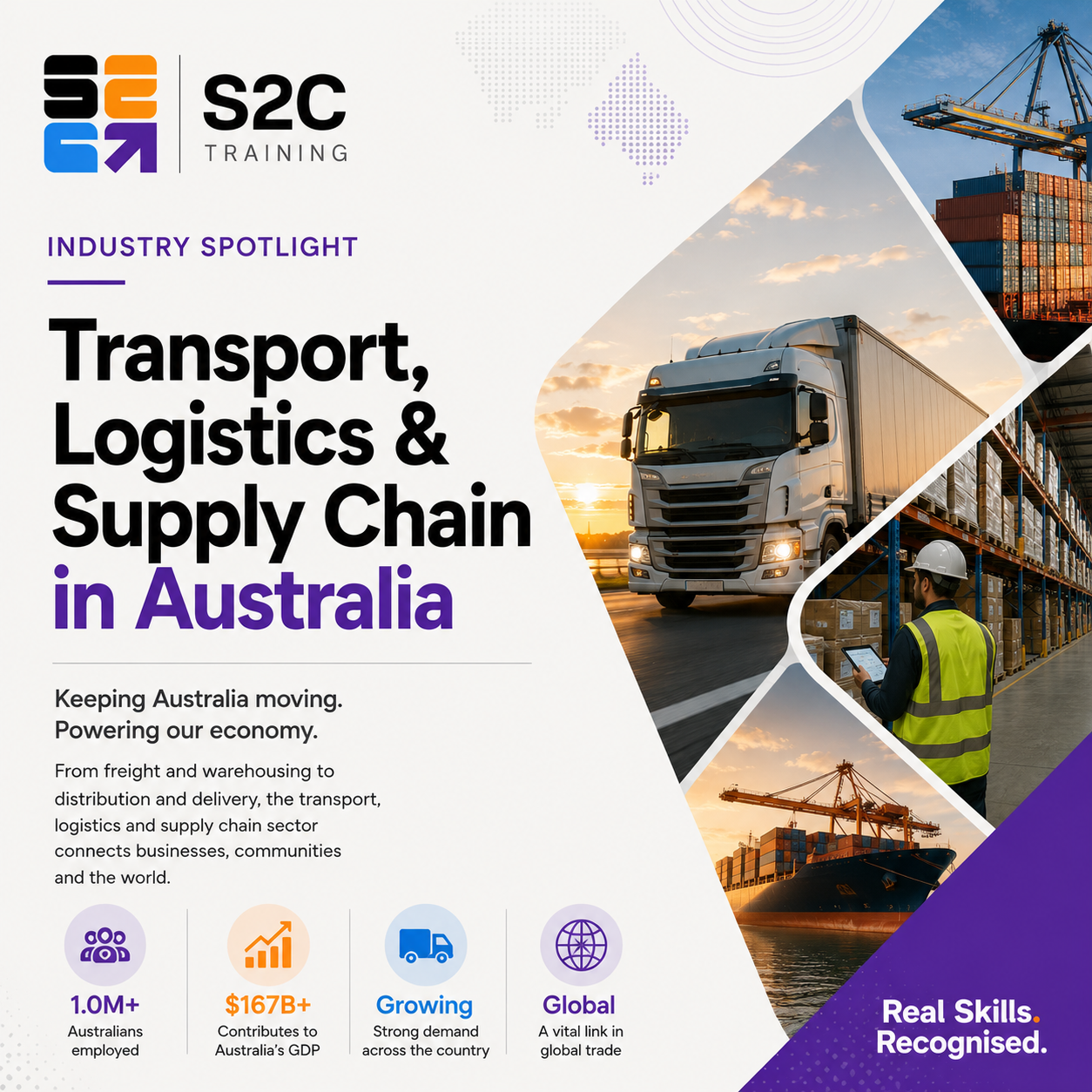
Transport, Postal and Warehousing is the engine room of the Australian economy: the industry that moves goods and people and keeps almost every other industry running. It employs around 745,400 people, about 5.1% of the workforce (JSA / ABS, to August 2025), and Jobs and Skills Australia projects steady growth over the coming decade, powered by e-commerce, population growth and major infrastructure. With a well-documented shortage of skilled workers, from drivers and warehouse staff to logistics coordinators, it is an industry actively looking for new entrants, and one where a recognised qualification opens doors quickly.
Workforce size: 745,400 people
Share of all Australian jobs: 5.1%
Median full-time earnings: $1,711 per week
Outlook: Projected 12% growth over the decade (JSA)
Who it suits: New starters, career changers, and experienced workers formalising skills
How big is the transport and logistics industry in Australia?
It is one of Australia's essential-service industries. Transport, Postal and Warehousing is the main job for around 745,400 people, roughly 5.1% of all workers (JSA industry profile, ABS Labour Force data to August 2025). Median full-time earnings sit at $1,711 per week, slightly above the all-industries median, the median age is 43, and only about 22% of the workforce is part-time, reflecting the industry's largely full-time, operational nature.
The industry is broad. Its biggest sector is Road Freight Transport (around 183,600 workers), followed by Warehousing and Storage Services, and Postal and Courier delivery (JSA, to August 2025). The largest single occupation is Truck Drivers, but the industry also employs a substantial workforce of storepersons, forklift drivers, despatch and logistics clerks, and supply, distribution and procurement managers. That mix matters: alongside frontline operators, there is a large and growing layer of coordination, administration and management roles.
How fast is it growing, and what is the jobs outlook?
Across the whole economy, Jobs and Skills Australia projects total employment to grow by nearly 2 million people (13.3%) over the decade to May 2035, reaching 16.6 million employed people (JSA employment projections). Transport, Postal and Warehousing is projected to grow at around 12% over that period, close to the national pace and adding tens of thousands of jobs.
Just as important as the headline number is the shape of demand. Industry bodies report persistent shortages across the sector. The Supply Chain and Logistics Association of Australia describes a widening 'skills cliff', with today's shortages in warehousing, driving and planning set to be compounded by future gaps in data analytics, automation and systems roles (SCLAA). In short, the industry needs people now and will need more, and increasingly different, skills as it modernises.
Why is the industry growing, and where is the investment going?
Three forces are driving demand. First, e-commerce: the shift to online shopping has permanently raised the need for warehousing, fulfilment and last-mile delivery. Second, population and infrastructure growth, which increases the movement of both goods and people. Third, modernisation, as the sector invests heavily in automation, robotics and digital systems.
That investment is substantial. Market analysts value Australia's supply chain management market at around US$949 million in 2025, projected to more than double by 2034 (IMARC Group). Warehouses are getting larger and more automated, and companies are building fulfilment capacity closer to customers. Crucially, automation does not remove the need for people, it changes it: the industry increasingly needs workers who can operate, coordinate and supervise technology-enabled operations, not fewer workers overall.
Is transport and logistics a good industry to get into?
For people who want secure, hands-on work with genuine progression, it is a strong choice. A few reasons stand out:
• It is essential and resilient. Goods have to move regardless of the economic cycle, which gives the industry a stable base of demand.
• Real entry points. Warehouse, driving and operational roles offer clear ways in without a degree, and are in active shortage.
• Fast progression. Because mid-level specialists are scarce, capable operators can move into coordination, supervisory and management roles relatively quickly.
• National demand. Every region needs logistics, so skills travel, including to regional and remote areas where shortages are sharpest.
• A modernising, tech-enabled future. For those interested in systems, data and automation, the industry is becoming more skilled and more interesting, not less.
The honest challenges: some frontline roles involve physical work, shift patterns and time away from home, particularly in long-haul transport. Coming in with a recognised qualification helps you target the settings and progression paths that suit you.
A day in the life: what the work actually looks like
The industry runs on a wide range of roles. Three snapshots show the range, including the operational and coordination work S2C's qualifications speak to.
The warehouse / supply chain operator
In a distribution centre, the operator is central to getting orders out accurately and on time: receiving and checking stock, safe storage and manual handling, picking and packing, operating equipment such as forklifts, and dispatching goods. Good operators quickly become the people who train new starters and keep the floor running, a natural stepping stone towards team leadership.
The logistics / despatch coordinator
A coordinator sits at the crossroads of the operation: scheduling deliveries, managing documentation and compliance, liaising with drivers, customers and suppliers, and using warehouse and transport management systems to keep everything on track. It is a role where organisation, communication and increasingly digital fluency turn a busy operation into a smooth one.
The transport / operations supervisor
Supervisors and operations managers coordinate teams, budgets, safety and performance across a site or fleet. With mid-level talent in short supply, this is where strong operators with the right leadership and management skills are in genuine demand, and where a recognised qualification makes the step up credible on paper.
Starting out or changing careers: how to get in
Transport and logistics is one of the more accessible industries for new entrants and career changers. Operational roles often have no formal entry requirement, and the sector is actively working to attract new talent, including younger workers and people from other fields. Industry bodies have been explicit about the need to market these careers differently and build clearer pathways to bring new people in (SCLAA).
For career changers from defence, emergency services, trades, retail or any operations-heavy background, the transferable skills, safety awareness, teamwork, coordination, working to procedure, are exactly what the industry values. A recognised qualification is often what turns that transferable experience into a foot in the door.
Upskilling, training and professional development
Logistics is a genuine career ladder. Entry-level operational qualifications lead into coordination, supervision and management, and the modernising nature of the industry rewards people who keep building digital, safety and leadership skills. As operations automate, the workers who pair hands-on experience with formal training and systems knowledge are the ones who progress.
For people already working in warehousing and logistics, Recognition of Prior Learning (RPL) is often the fastest route to a qualification. Much of the work, safe manual handling, receival and dispatch, stock control, equipment operation, teamwork, maps directly to qualification units, so an assessor can credit what you already do rather than making you relearn it.
Where S2C Training fits: qualifications for the logistics workforce
S2C Training is a Registered Training Organisation (RTO 45605) that turns real experience into nationally recognised qualifications, delivered through blended online learning and workplace-based assessment and assessed by qualified trainers and assessors. For the transport and logistics workforce, the relevant pathway runs from operational recognition into safety and leadership.
• Certificate III in Supply Chain Operations - for warehouse and logistics operators, store and dispatch staff, and freight handlers formalising their hands-on skills.
• Certificate IV in Work Health and Safety - for those taking on safety responsibility in a warehouse or transport operation, where WHS is central to the work.
• Certificate IV in Leadership and Management - for operators stepping up into team-leader, supervisor and operations-management roles.
Each can often be completed via RPL for those with relevant experience, producing a credential that matches the work you already do and positions you for the roles this growing industry most needs to fill.
Pathway: from the warehouse floor to team leader
"Jordan" spent three years across receival, picking and dispatch in a distribution centre and had become the person who trained new starters, but held no qualification. Through S2C's Certificate III in Supply Chain Operations via RPL and workplace-based assessment, Jordan turned that hands-on experience into a nationally recognised credential. With the qualification on paper, Jordan was taken seriously for a team-leader role, and started looking at a Certificate IV in Leadership and Management as the next step.
Where to from here
Transport, logistics and supply chain is an essential, modernising industry with a well-documented appetite for new people, and clear progression for those who build their skills. If you already work in it, or you want a hands-on way in with room to grow, the fastest move is often to get your skills formally recognised.
Book a free skills check with S2C Training to see how your experience maps to a nationally recognised qualification in this growing industry.
Frequently asked questions
How many people work in transport and logistics in Australia?
Around 745,400 people have their main job in the Transport, Postal and Warehousing industry, about 5.1% of the Australian workforce, according to Jobs and Skills Australia and ABS Labour Force data to August 2025. The largest sector is road freight transport and the largest occupation is truck drivers.
Is the logistics industry growing in Australia?
Yes. Jobs and Skills Australia projects Transport, Postal and Warehousing to grow by around 12% over the decade to 2035, driven by e-commerce, population growth and infrastructure investment. Industry bodies also report persistent skills shortages, meaning strong ongoing demand for workers.
What qualifications do you need to work in a warehouse or logistics in Australia?
Many operational roles have no formal entry requirement, but a vocational qualification such as a Certificate III in Supply Chain Operations helps you stand out, formalises your skills and supports progression. Experienced workers can often gain the qualification through Recognition of Prior Learning.
Can I get into logistics without experience?
Yes. Warehouse, driving and operational roles are a common entry point and are in active shortage. Transferable skills from trades, defence, emergency services or retail translate well, and a recognised qualification helps convert that background into a job and a career pathway.
Why is there a skills shortage in transport and logistics?
Demand from e-commerce, manufacturing and infrastructure has risen while fewer new entrants have chosen the sector and experienced staff have moved into senior roles. Industry bodies also point to an ageing workforce and a growing need for digital and automation skills, widening the gap.
What is Recognition of Prior Learning (RPL) in supply chain operations?
RPL credits the skills and knowledge you have already gained on the job, such as manual handling, receival and dispatch, stock control and equipment operation, towards a nationally recognised qualification, so experienced operators can formalise their capability without repeating training.
Sources & further reading (for your records)
• JSA - Transport, Postal and Warehousing industry profile: https://www.jobsandskills.gov.au/data/occupation-and-industry-profiles/industries/transport-postal-and-warehousing
• JSA - Employment projections (to May 2035): https://www.jobsandskills.gov.au/data/employment-projections
• Australian Jobs 2025 (yourcareer.gov.au): https://content.yourcareer.gov.au/sites/default/files/2025-06/Australian%20Jobs%202025.pdf
• SCLAA - The supply chain skills cliff: https://www.sclaa.com.au/the-supply-chain-skills-cliff-todays-gaps-are-tomorrows-crisis/
• SCLAA - Attracting next-gen to supply chain and logistics: https://www.sclaa.com.au/attracting-next-gen-to-supply-chain-and-logistics/
• IMARC - Australia supply chain management market (third-party estimate): https://www.imarcgroup.com/australia-supply-chain-management-market
More to explore
Keep reading to find insights that matter to your growth

Start your Qualification Journey Today. Obligation Free.
No guesswork. A clear, supported pathway to recognising your experience - with training only where it's needed.
.png)