Recognition of Prior Learning for Emergency Services Personnel
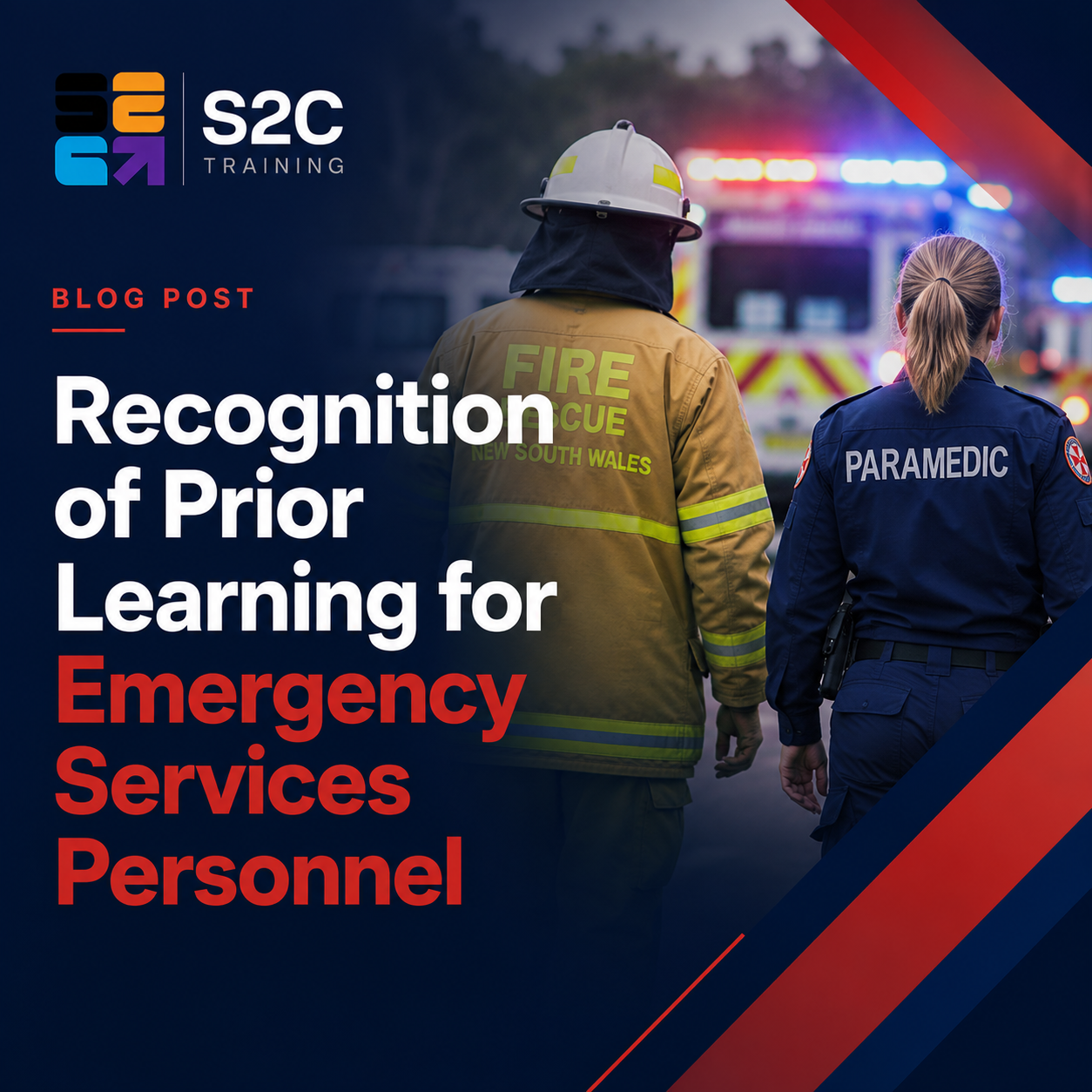
Recognition of Prior Learning for Emergency Services Personnel
Emergency services personnel spend their careers developing exactly the kind of skills employers value most: leadership under pressure, clear decision-making, coordination, communication and an instinct for risk and safety. Yet many first responders find that this hard-won capability isn’t reflected in formal qualifications. Recognition of Prior Learning (RPL) exists to close that gap - turning frontline experience into nationally recognised credentials.
This guide looks at how RPL works for emergency services and first responders, which skills tend to translate, and how to take the first step.
Who this applies to
RPL can suit personnel from right across the emergency services and first-responder community, including those who have served - or are still serving - in areas such as:
• Police
• Fire and rescue
• Ambulance and paramedicine
• State Emergency Service (SES)
• Other first-responder and emergency-management roles
Whether you’re changing careers, transitioning after years of service, or simply want formal recognition for what you already do, your experience may already align with a nationally recognised qualification.
Which skills translate into qualifications?
Emergency service work develops capability that maps into many of the areas S2C Training offers qualifications in. Some of the strongest examples include:
Leadership and management
Leading teams in high-pressure situations, coordinating responses, briefing and debriefing, and taking responsibility for outcomes are core leadership and management competencies - often developed to a level many civilian managers never reach.
Work health and safety
Risk assessment, hazard identification, incident management and a deeply ingrained safety culture are second nature to first responders, and align closely with formal work health and safety qualifications.
Project and operational coordination
Planning operations, allocating resources and managing logistics under time pressure reflect the skills behind project management and operational qualifications.
These are illustrations rather than guarantees - your own outcome depends on assessment - but they show how routine frontline work can translate into formal recognition. To understand the underlying process, see “What Is Recognition of Prior Learning (RPL)?”
How the RPL process works for first responders
The process mirrors RPL more broadly: you map your experience against a chosen qualification, gather evidence, and have a qualified assessor confirm your competency. For emergency services personnel, useful evidence often includes position descriptions, service records, training and course records, incident or operational documentation (where appropriate and permitted), and references from senior colleagues.
A practical tip: gather what you can while you still have ready access to it. For more detail, our guide “What Evidence Do I Need for RPL?” walks through exactly what counts.
RPL is often faster than studying a qualification from scratch, because it recognises what you can already do. Timeframes vary case by case depending on your evidence and how closely your experience matches the qualification. Cost varies too, and depends on the qualification and whether any gap training is needed - we publish RPL pricing on each individual course page so you can see the figure for the qualification you’re interested in. The clearest first step is to have your experience assessed, so you’re only ever looking at what you actually need.
Why recognition matters when you’re changing careers
For personnel moving into a new career or life stage, a nationally recognised qualification does two things. It translates your experience into language civilian employers immediately understand, and it opens doors - to roles, promotions and further study - that experience alone may not. After years of service, that recognition can make the next step considerably smoother. It can also give you confidence: seeing your capability mapped against a national standard is a powerful reminder of just how much you already know as you step into something new.
How S2C Training supports emergency services personnel
Emergency services and first responders have long been central to who we are. S2C Training (RTO 45605) offers an RPL pathway across every one of our nationally recognised qualifications - including leadership and management, project management, work health and safety, health administration and supply chain operations - the very areas where frontline experience tends to map across well.
Take the next step
Ready to turn your service into a qualification? Start with a free skills check - the simplest way to see how much of your experience can be formally recognised. Get started at www.s2c.edu.au
More to explore
Keep reading to find insights that matter to your growth
Start your Qualification Journey Today. Obligation Free.
No guesswork. A clear, supported pathway to recognising your experience - with training only where it's needed.
.png)