
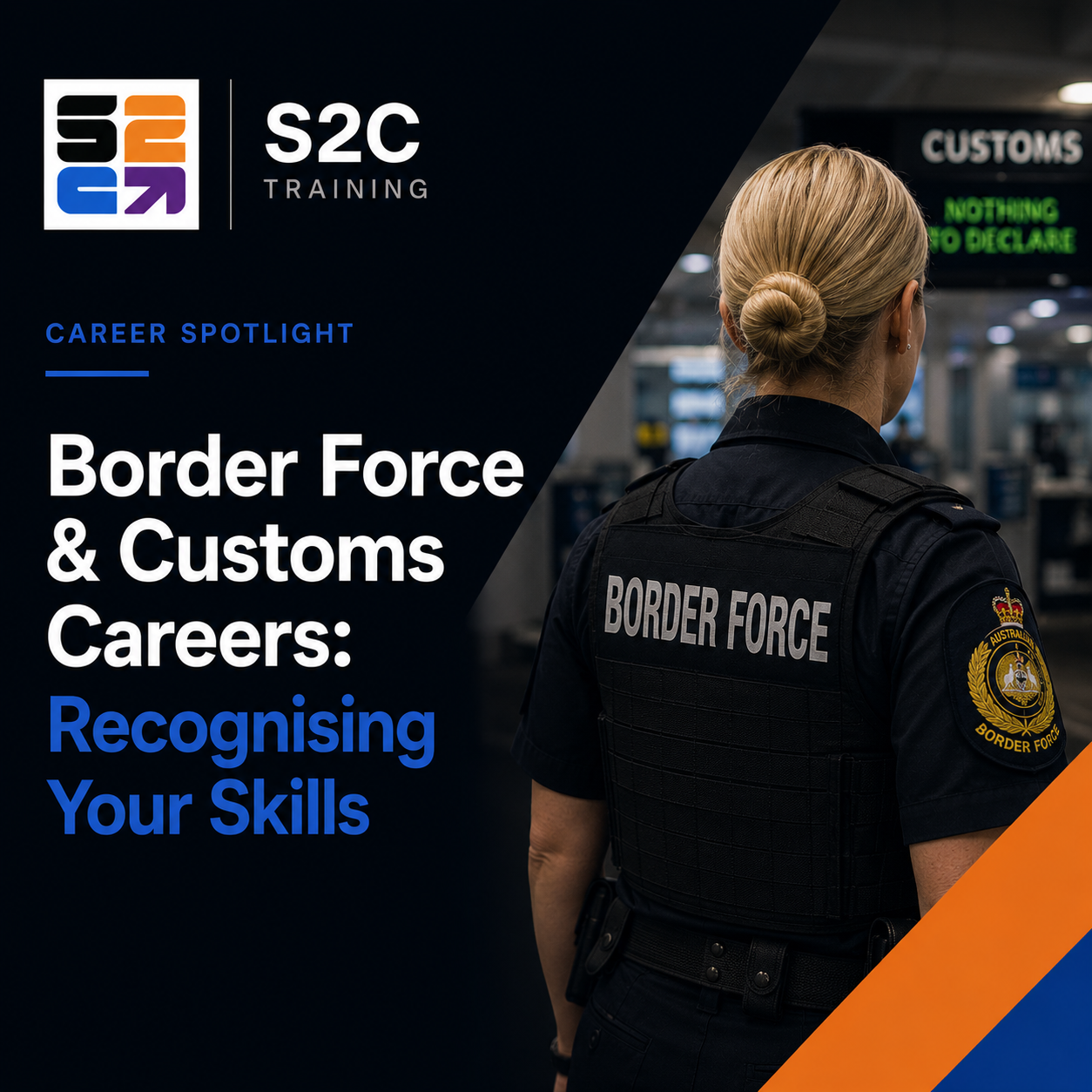
Border Force & Customs Careers: Recognising Your Skills
The quick answer
Australian Border Force (ABF) officers protect the border across airports, seaports, cargo and mail centres, remote locations and Australia's maritime domain, building sharp skills in investigation, compliance, risk assessment, intelligence and operational leadership. Notably, the ABF's own entry pathway asks for a Certificate IV or Diploma-level qualification or relevant work experience, recognising the vocational level of the role (Australian Border Force careers). For officers formalising that capability or moving into civilian roles, Recognition of Prior Learning (RPL) turns border-protection experience into nationally recognised qualifications.
The agency: Australian Border Force - the operational enforcement arm of Home Affairs
Scope: Airports, seaports, cargo, mail, remote sites and the maritime domain
Transferable strengths: Investigation, compliance, risk, intelligence, leadership
Fastest route to recognition: RPL against nationally recognised qualifications
A note on Customs and Coastguard
The former Australian Customs Service was absorbed into what is now the Australian Border Force, so customs functions, examining goods, cargo and travellers, are today part of the ABF. Australia has no single national 'Coastguard'; maritime border enforcement is carried out by the ABF's marine operations, while volunteer marine search and rescue is provided by bodies such as the Australian Volunteer Coast Guard. Whichever term you started with, the transferable skills, and the way RPL recognises them, are the same.
What skills do Border Force officers build?
Border work is varied and demanding. Officers assess risk and detect threats in real time, investigate illicit activity, interpret and enforce complex legislation, gather and act on intelligence, work in disciplined teams, and make consequential decisions under scrutiny. Many also develop specialist skills in areas like cargo and trade, immigration, detector dogs, or marine operations.
Those are precisely the capabilities that underpin civilian roles in compliance, investigations, risk, security, logistics and operational leadership, fields where employers actively seek people who can apply rules rigorously and act decisively.
Where do Border Force skills translate?
• Compliance and investigations - interpreting and enforcing rules, gathering evidence, documenting decisions.
• Risk and security - threat assessment and risk management are core to the role.
• Leadership and operations - coordinating disciplined teams in high-stakes settings.
• Logistics, trade and supply chain - for officers with cargo, freight and border-trade experience.
How Recognition of Prior Learning works for Border Force officers
RPL assesses what you already do against a nationally recognised qualification, rather than making you start over. For ABF officers, evidence is plentiful: operational and investigation records, compliance decisions, risk assessments, intelligence work and team leadership. An assessor maps it against the qualification's units.
Related guides: Recognition of Prior Learning for Emergency Services Personnel · What Evidence Do I Need for RPL? · Can I Get a Qualification Based on Work Experience?
Which S2C qualifications map to Border Force experience?
S2C Training (RTO 45605) turns service experience into nationally recognised qualifications through blended delivery and workplace-based assessment. For ABF and former customs officers, the natural fits are:
• Certificate IV in Leadership and Management and the Advanced Diploma of Leadership and Management - for operational and team leadership.
• Certificate IV in Business - for compliance, administration and operational capability that travels widely.
• Certificate IV in Work Health and Safety - for the risk and safety expertise built in frontline border work.
• Certificate III in Supply Chain Operations - for officers with cargo, freight and trade experience.
Pathway example: from Border Force officer to compliance lead
"Sam" spent years as an ABF officer working cargo and investigations, interpreting complex legislation and leading a team on shift. Moving into the private sector, Sam used S2C's Certificate IV in Leadership and Management via RPL to formalise that operational leadership into a nationally recognised qualification, and stepped into a corporate compliance role where the risk and rules mindset was exactly what the employer wanted.
Where to from here
The investigation, compliance and leadership skills you use at the border are in real demand across the civilian economy. The fastest way to make them count is to get them formally recognised.
Complete a free skills check with S2C Training to see how your Border Force or customs experience maps to a nationally recognised qualification.
Frequently asked questions
Is Customs still a separate agency in Australia?
No. The former Australian Customs Service was absorbed into the Australian Border Force (ABF) in 2015. Customs functions, such as examining goods, cargo and travellers, are now carried out by the ABF, the operational enforcement arm of the Department of Home Affairs.
What civilian jobs suit former Border Force officers?
Border Force experience translates strongly into compliance and investigations, risk and security, operational leadership, and logistics or supply-chain roles. Employers value the ability to interpret and enforce rules, assess risk and act decisively.
Can Border Force officers get civilian qualifications through RPL?
Yes. Through Recognition of Prior Learning (RPL), ABF officers can have their investigation, compliance, risk and leadership experience assessed against nationally recognised qualifications, without repeating training they already apply on the job.
Is there a Coastguard in Australia?
Australia has no single national Coastguard. Maritime border enforcement is carried out by the Australian Border Force's marine operations, while volunteer marine search and rescue is provided by bodies such as the Australian Volunteer Coast Guard and state marine rescue services.
More to explore
Keep reading to find insights that matter to your growth
Start your Qualification Journey Today. Obligation Free.
No guesswork. A clear, supported pathway to recognising your experience - with training only where it's needed.
.png)