Police to Civilian Careers: Turning Your Experience into Qualifications
The quick answer
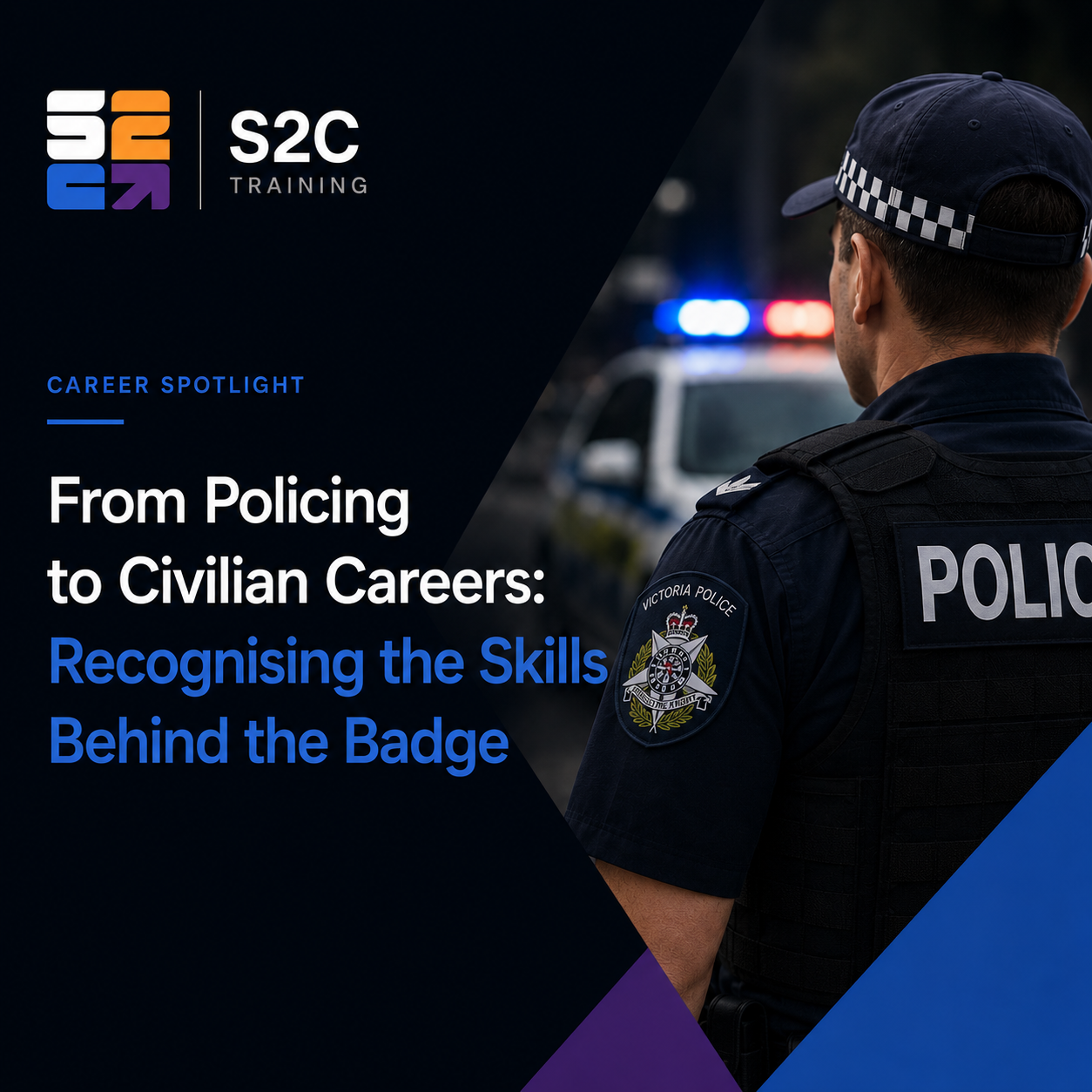
Police officers spend their careers building leadership, judgement, risk management and communication skills that civilian employers value highly, but often without civilian qualifications to show for it. With around 59,359 sworn police officers across Australia and shortages reported in every state and territory (Public Skills Australia, Workforce Plan 2025: Public Safety), policing is a large, high-skill workforce, and many officers reach a point where they want their capability formally recognised, whether to progress, to transition, or simply to have it on paper. Recognition of Prior Learning (RPL) is often the fastest way to do exactly that.
Workforce: 59,359 sworn officers nationally (Public Skills Australia)
Skill level: Policing is an ANZSCO Skill Level 2 occupation
Transferable strengths: Leadership, risk, decision-making, investigation, communication
Fastest route to recognition: RPL against nationally recognised qualifications
What skills do police officers actually build?
Policing is one of the most capability-dense careers there is. Day to day, officers lead and coordinate teams, make high-stakes decisions under pressure, assess and manage risk, gather and analyse evidence, resolve conflict, and communicate with everyone from victims to senior command. Those are not niche policing skills, they are the core competencies that underpin leadership, management, investigation, compliance and operations roles right across the civilian economy.
The classification system reflects this. Policing is an ANZSCO Skill Level 2 occupation, on par with paramedics and construction managers (JSA / ABS occupation data), which recognises the diploma-and-above level of skill the role demands. The challenge is that this capability is rarely captured in a portable, civilian-recognised qualification, which is where recognition matters.
Where do policing skills translate?
Common civilian destinations for policing experience include leadership and operations management, workplace health and safety, investigations and compliance, security and risk, project and program coordination, and community and government roles. The through-line is the same: the ability to lead people, manage risk and get outcomes in complex, high-pressure environments.
• Leadership and management - supervising teams, running operations, managing performance.
• Work health and safety - risk assessment, incident response and a safety-first mindset are second nature.
• Project and program coordination - planning, resourcing and delivering complex tasks to a standard.
• Business and administration - the organisational backbone of any operation.
How Recognition of Prior Learning works for police
Rather than studying from scratch, RPL assesses what you already know and do against the units in a nationally recognised qualification. For police officers, evidence is rarely the problem, years of operational reports, leadership of teams, incident management and documented decision-making all count. An assessor maps that evidence to the qualification, and where it meets the standard, you may not need to repeat that learning.
This blog focuses on the policing angle specifically. For the full step-by-step of how RPL works across all emergency services, and what counts as evidence, see the guides below rather than starting from zero here.
Related guides: Recognition of Prior Learning for Emergency Services Personnel What Evidence Do I Need for RPL? Can I Get a Qualification Based on Work Experience?
Which S2C qualifications map to policing experience?
S2C Training is a Registered Training Organisation (RTO 45605) that specialises in turning frontline and service experience into nationally recognised qualifications, delivered through blended online learning and workplace-based assessment, and assessed by qualified trainers and assessors. For officers formalising or transitioning their capability, the natural fits are:
• Certificate IV in Leadership and Management and the Advanced Diploma of Leadership and Management - for the team leadership and operational command policing builds.
• Certificate IV in Work Health and Safety - for the risk and safety expertise that underpins frontline work.
• Certificate IV in Project Management Practice - for the planning and coordination skills used in every operation.
• Certificate IV in Business - for broad administrative and operational capability that travels anywhere.
Pathway example: from sergeant to operations manager
"Chris" spent fifteen years in the police, the last five as a sergeant leading a team, managing rosters, and running operations under pressure, but had no civilian qualification reflecting that leadership. Planning a move into the private sector, Chris used S2C's Advanced Diploma of Leadership and Management via RPL, drawing on documented command and operational experience. The nationally recognised qualification gave civilian employers a clear, credible signal of leadership capability, and Chris moved into an operations manager role.
Where to from here
Your policing experience is worth more on paper than it currently shows. Whether you're progressing, transitioning, or just want recognition for what you already do, the fastest step is to get your skills formally assessed.
Complete a free skills check with S2C Training to see how your policing experience maps to a nationally recognised qualification.
Frequently asked questions
Can police officers get civilian qualifications for their experience?
Yes. Through Recognition of Prior Learning (RPL), police officers can have their leadership, risk management, investigation and operational experience assessed against nationally recognised qualifications, often in areas like leadership and management, work health and safety, or project management, without repeating training they effectively already know.
What civilian jobs suit former police officers?
Policing skills translate strongly into leadership and operations management, work health and safety, investigations and compliance, security and risk, and project coordination. The common thread is leading people and managing risk in complex, high-pressure environments.
Is there a police shortage in Australia?
Yes. Public Skills Australia's Workforce Plan 2025: Public Safety reports that police organisations are experiencing shortages of officers across all states and territories, with around 59,359 sworn officers nationally, driven by recruitment, retention and regional factors.
What qualification level is policing?
Policing is classified as an ANZSCO Skill Level 2 occupation, the same level as paramedics and construction managers, reflecting the diploma-and-above level of skill the role requires.
More to explore
Keep reading to find insights that matter to your growth
Start your Qualification Journey Today. Obligation Free.
No guesswork. A clear, supported pathway to recognising your experience - with training only where it's needed.
.png)