
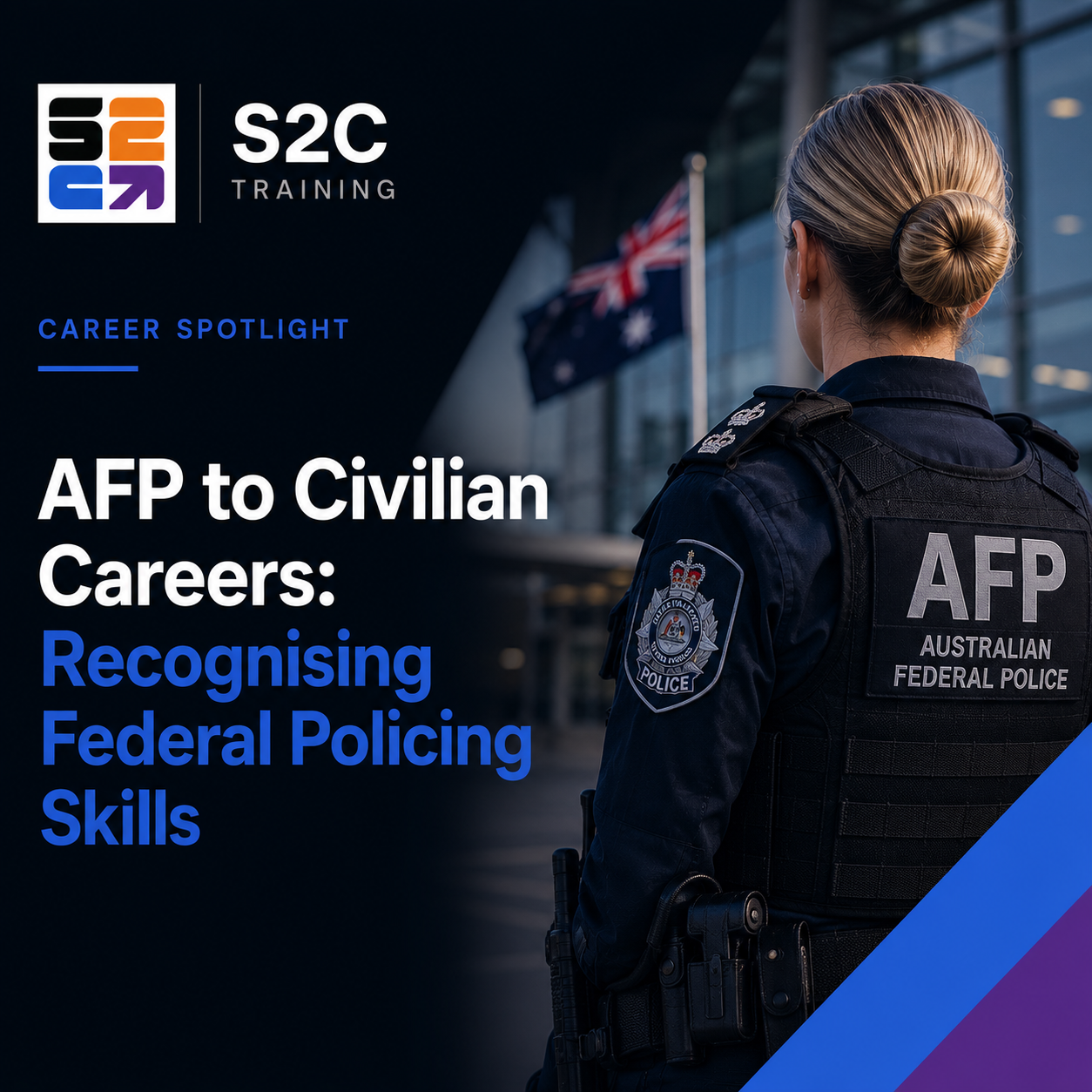
AFP to Civilian Careers: Recognising Federal Policing Skills
The quick answer
The Australian Federal Police (AFP) is Australia's national policing agency, tackling everything from serious and organised crime to national security, cybercrime, aviation and close protection. It is a substantial, specialised workforce: the AFP reported 8,328 staff as at 30 June 2025, across sworn police officers, protective service officers and specialist professional staff (AFP Annual Report 2024-25), working in over 200 role types. For officers and staff formalising their capability or planning a civilian move, Recognition of Prior Learning (RPL) turns AFP experience into nationally recognised qualifications.
Workforce: 8,328 staff (AFP, at 30 June 2025)
Breadth: 200+ role types - sworn, protective service and specialist
Transferable strengths: Investigation, intelligence, leadership, risk, coordination
Fastest route to recognition: RPL against nationally recognised qualifications
How is the AFP different from state police?
While state and territory police handle community policing within their jurisdiction, the AFP is the national agency, responsible for enforcing Commonwealth law and protecting national interests. Its work spans serious and organised crime, counter-terrorism and national security, cybercrime, fraud, aviation policing, and the protection of people and places. That breadth means AFP experience often carries a strong specialist and intelligence dimension on top of core policing skills.
What skills do AFP officers and staff build?
Federal policing builds a deep, transferable skill set: complex investigation, intelligence gathering and analysis, risk and threat assessment, operational and team leadership, stakeholder coordination across agencies and borders, and disciplined decision-making. The AFP's substantial cohort of specialist and professional staff, in areas like forensics, cyber, intelligence and corporate functions, adds technical and analytical depth alongside operational capability.
These are exactly the competencies civilian employers seek for leadership, investigations, compliance, risk, security and analytical roles, particularly in sectors where integrity and rigour matter.
Where do AFP skills translate?
• Leadership and operations management - coordinating teams and complex operations.
• Investigations and compliance - evidence, analysis and rigorous decision-making.
• Risk, security and intelligence - assessing and managing threats in the private and public sectors.
• Project and program coordination - planning and delivering complex, multi-stakeholder work.
How Recognition of Prior Learning works for AFP members
RPL credits the leadership, investigation and coordination experience you already hold against a nationally recognised qualification. Evidence like documented investigations, team and operational leadership, risk assessments and program coordination maps directly to qualification units, so experienced members can be recognised for capability they use daily.
Related guides: Recognition of Prior Learning for Emergency Services Personnel · Can I Get a Qualification Based on Work Experience? · Recognition of Prior Learning vs Credit Transfer
Which S2C qualifications map to AFP experience?
S2C Training (RTO 45605) turns service experience into nationally recognised qualifications through blended delivery and workplace-based assessment. For AFP officers and staff, the natural fits are:
• Certificate IV in Leadership and Management and the Advanced Diploma of Leadership and Management - for the operational and team leadership federal policing builds.
• Certificate IV in Project Management Practice and the Diploma of Project Management - for coordinating complex, multi-stakeholder operations.
• Certificate IV in Work Health and Safety - for the risk and safety expertise built in operational roles.
• Certificate IV in Business - for broad operational and administrative capability, including for professional staff.
Pathway example: from AFP investigator to risk manager
"Chris" spent over a decade with the AFP in investigations and intelligence, leading teams on complex, multi-agency operations. Planning a move into corporate risk, Chris used S2C's Advanced Diploma of Leadership and Management via RPL to formalise years of operational leadership into a nationally recognised qualification, giving employers a clear signal of the capability behind the service record.
Where to from here
Federal policing builds leadership, investigation and analytical skills that civilian employers actively seek. Whether you're progressing, transitioning, or planning ahead, the fastest step is to get your skills formally recognised.
Complete a free skills check with S2C Training to see how your AFP experience maps to a nationally recognised qualification.
Frequently asked questions
What is the difference between the AFP and state police?
State and territory police handle community policing within their jurisdiction, while the Australian Federal Police is the national agency enforcing Commonwealth law. The AFP covers serious and organised crime, national security, cybercrime, aviation policing and protection, often with a strong specialist and intelligence dimension.
How many people work for the AFP?
The Australian Federal Police reported 8,328 staff as at 30 June 2025, comprising sworn police officers, protective service officers and specialist professional staff across more than 200 role types, located across Australia and overseas.
What civilian jobs suit former AFP officers?
AFP experience translates strongly into leadership and operations management, investigations and compliance, risk, security and intelligence roles, and project or program coordination, particularly in sectors where integrity and analytical rigour are valued.
Can AFP staff get civilian qualifications through RPL?
Yes. Through Recognition of Prior Learning (RPL), AFP officers and professional staff can have their leadership, investigation, intelligence and coordination experience assessed against nationally recognised qualifications, without repeating training they already apply at work.
More to explore
Keep reading to find insights that matter to your growth
Start your Qualification Journey Today. Obligation Free.
No guesswork. A clear, supported pathway to recognising your experience - with training only where it's needed.
.png)