Supply Chain Operations Qualifications: Formalise the Skills That Keep Goods Moving
Intro
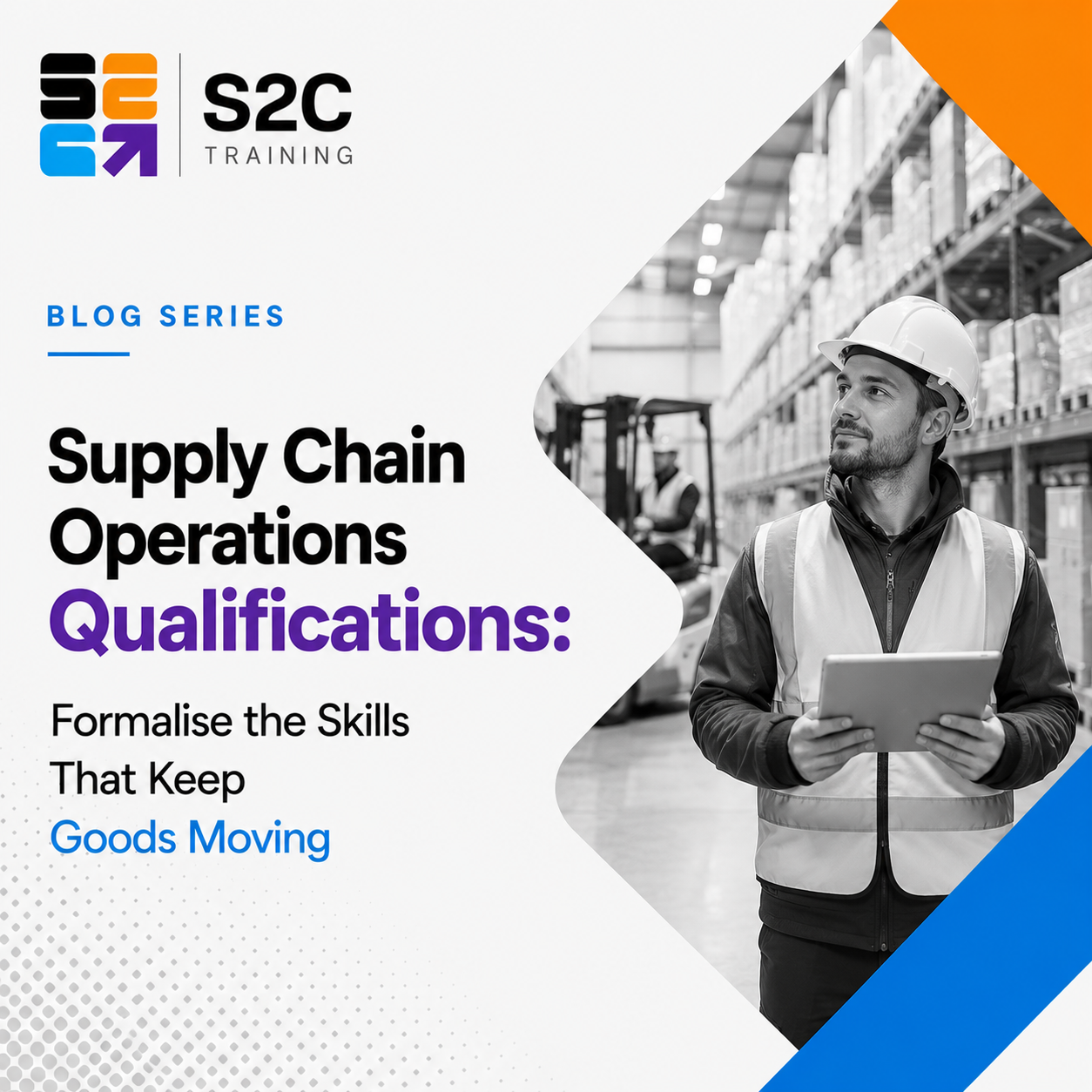
Every product that reaches a customer passes through people who receive, store, pick, pack and dispatch it safely and on time. If you have worked in a warehouse, store or logistics operation and built real capability, a Supply Chain Operations qualification turns that hands-on experience into a nationally recognised credential and a foundation to progress.
This blog covers the qualification, the roles it leads to, and how existing operational experience can be formally recognised.
Qualifications Covered
S2C offers an entry-to-operational Supply Chain Operations qualification for people already working in, or moving into, warehousing and logistics.
• Certificate III in Supply Chain Operations - for warehouse and logistics operators, store and dispatch staff, and freight handlers formalising their operational skills.
Career Insights & Industry Stats
Supply chain and logistics underpin nearly every industry, and demand for reliable operational staff has stayed strong as businesses invest in getting goods to customers efficiently. As Australian employment grows over the decade to May 2034, operational roles that keep supply chains running remain a steady entry point with clear progression into coordination and management.
Formalising Experience via RPL
Warehouse and logistics work is highly practical, and much of it maps directly to qualification units: safe manual handling, receival and dispatch, stock control, equipment operation and teamwork. Through Recognition of Prior Learning (RPL), an assessor reviews evidence of what you already do on shift and credits it towards the qualification.
Related guides: What Is Recognition of Prior Learning (RPL)? Can I Get a Qualification Based on Work Experience?
Delivery
S2C delivers Supply Chain Operations in a blended model: online learning with trainer support, and practical assessment grounded in your real workplace or a suitable simulated operational environment. Because this qualification is hands-on, workplace-based evidence is central.
As a Registered Training Organisation (RTO 45605), S2C issues a nationally recognised Supply Chain Operations qualification, assessed by qualified trainers and assessors with the required credentials and current industry knowledge.
Case Study
"Jordan" worked three years across receival, picking and dispatch in a distribution centre and had become the person who trained new starters, but held no qualification. Through S2C's Certificate III in Supply Chain Operations via RPL and workplace-based assessment, Jordan gained a nationally recognised credential, then set sights on a Certificate IV to move towards a team-leader role.
Where to From Here
Complete the free skills check with S2C Training to see how your warehouse and logistics experience maps to a nationally recognised qualification.
More to explore
Keep reading to find insights that matter to your growth
Industry Spotlight - Mining, Resources & Energy in Australia
The quick answer
Mining is the highest-paid industry in Australia and the backbone of its exports. It is the main job for around 321,300 people, about 2.2% of the workforce, but with the highest median pay of any industry at $2,649 per week (JSA / ABS, to mid-2025). It is concentrated in Western Australia and Queensland, much of it fly-in fly-out (FIFO) in regional and remote areas, and it faces a serious shortage of skilled workers. Mining doesn't only need drillers and engineers, it runs on safety, project, leadership and operational people too, which is where a recognised qualification, and a background in discipline and teamwork, opens the door.
Workforce size: ~321,300 people (~2.2% of jobs)
Median full-time earnings: $2,649 per week (highest of any industry)
Where the work is: Mostly WA & Queensland; heavily regional, remote and FIFO
Economy: Resources & energy ~two-thirds of Australia's exports, ~14% of GDP
Where S2C fits: Safety, project, leadership & operational roles — a strong veteran fit
How big is the mining industry in Australia?
By headcount, mining is a relatively small industry: it is the main job for around 321,300 people, roughly 2.2% of the workforce, with only about 4% working part-time and around 21% of the workforce female (JSA industry profile, ABS data to mid-2025). The median age is 41. But by value and by pay, it punches far above its size: median full-time earnings of $2,649 per week are the highest of any Australian industry, well above the all-industries median of around $1,700.
Its largest sector is Metal Ore Mining (around 144,700 workers), followed by mining support services, coal mining, exploration, and oil and gas extraction (JSA, to mid-2025). The largest single occupation is Drillers, Miners and Shot Firers, alongside truck and plant operators, engineers, geologists, metallurgists and a substantial trades and technical workforce. Most jobs are in Western Australia and Queensland, concentrated in regional and remote locations like the Pilbara and Gladstone.
The economic weight is enormous. Australia's resources and energy exports were worth around $385 billion in 2024–25, roughly two-thirds of the country's total merchandise exports and about 14% of GDP (Office of the Chief Economist / ABS data). Australia is the world's largest iron ore exporter and largest lithium producer, and mining supports well over a million more jobs across the equipment, technology and services businesses that surround it.
What is the jobs outlook, and is there a skills shortage?
Mining employment has grown strongly over the long term, and while growth is expected to be steadier rather than booming over the coming years, demand for skilled people remains high. The Minerals Council of Australia describes the industry as facing some of the worst skills and labour shortages in a generation, with severe shortages across occupations from drillers and drivers to engineers, geologists and metallurgists (Minerals Council of Australia).
Two forces are reshaping the workforce. First, technology: mining is becoming more automated and data-driven, lifting demand for digital, technical and analytical skills alongside traditional roles. Second, the energy transition: demand for critical minerals like lithium and copper, and the build-out of new energy projects, is creating fresh, long-run demand for people. The industry is actively investing in training partnerships and new pathways to fill the gap.
Is mining a good industry to get into?
For people who are open to remote or FIFO work, it offers some of the best pay and conditions in the country. A few reasons stand out:
• The highest pay in the country. Median full-time earnings lead every other industry, and many operational roles pay well above the national average.
• Secure, full-time work. The vast majority of mining roles are permanent and full-time, with only around 4% part-time.
• Strong demand for people. With generational skills shortages, capable, safety-minded, reliable workers are genuinely sought after.
• More than trades and engineers. Mining needs safety officers, supervisors, project and operations people, and coordinators, roles open to capable people from many backgrounds.
• A natural fit for ex-service personnel. The roster discipline, resilience and teamwork of FIFO work suit people from defence and emergency-services backgrounds especially well.
The honest challenges: FIFO and remote work mean significant time away from home and demanding rosters, and the lifestyle isn't for everyone. Going in with clear expectations, the right safety mindset and a recognised qualification helps you land the roles and rosters that suit you.
A day in the life: the roles that keep a mine running safely
Mining is far more than operating machinery. Three snapshots show the non-technical roles S2C's qualifications speak to, the people who keep operations safe, coordinated and productive.
The WHS / site safety advisor
Safety is the mining industry's stated number-one value, and for good reason, it is high-consequence work. The site safety advisor runs inductions and toolbox talks, completes risk assessments and inspections, investigates incidents, and keeps the operation compliant. On a mine site, this is one of the most respected and in-demand non-operator roles, and one where getting it right genuinely saves lives.
The supervisor / operations leader
Supervisors coordinate crews, rosters, safety and production across a shift or area, balancing people, targets and standards in a demanding environment. With skilled people scarce, strong operators who can lead a crew are exactly what sites need, and leadership capability is what turns a good operator into a supervisor.
The project / operations coordinator
Mining runs on major projects and complex logistics, from expansions and shutdowns to supply and equipment coordination. Project and operations coordinators keep scope, schedule, budget and resources on track. As the industry takes on critical-minerals and energy-transition projects, these coordination skills are increasingly valuable.
Mining and ex-service personnel: a natural fit
Few career transitions map as cleanly as defence or emergency services into mining. FIFO and remote operations run on exactly the attributes service backgrounds build: comfort with rosters and time away from home, safety discipline, teamwork under pressure, and the ability to follow and enforce procedure. Mining companies increasingly recognise ex-service personnel as a strong source of reliable, safety-minded workers, particularly for supervisory, safety and coordination roles.
For transitioning ADF members and veterans, the move often comes down to translating service experience into civilian-recognised qualifications. See How Military Experience Translates into Civilian Qualifications, Civilian Career Pathways for Veterans and Qualifications for Transitioning Defence Personnel.
Upskilling, training and professional development
Mining rewards people who build recognised capability. On the non-operator side, that often means formalising safety expertise with a WHS qualification, or stepping into leadership, project and business qualifications as you move from crew member to supervisor to operations leadership. In a safety-critical, compliance-heavy industry, recognised qualifications are frequently what unlock the next role and roster.
For people already working in or around mining, resources or heavy industry, Recognition of Prior Learning (RPL) can be the fastest route to a formal qualification. Safety leadership, crew supervision, project and logistics coordination all generate evidence an assessor can map against a qualification, so experienced site people can formalise their capability without starting from scratch.
Where S2C Training fits: qualifications for the mining workforce
S2C Training is a Registered Training Organisation (RTO 45605) that turns real experience into nationally recognised qualifications, delivered through blended online learning and workplace-based assessment and assessed by qualified trainers and assessors. S2C does not deliver mining tickets, high-risk-work licences or trade and engineering qualifications; instead, it credentials the safety, leadership, project and business capability that mining operations equally depend on.
• Certificate IV in Work Health and Safety - for safety representatives and supervisors moving into a dedicated WHS advisor or officer role on site.
• Certificate IV in Leadership and Management and the Advanced Diploma of Leadership and Management - for crew members stepping up to supervisor and operations-leadership roles.
• Certificate IV in Project Management Practice and the Diploma of Project Management - for the people coordinating shutdowns, expansions and complex site projects.
• Certificate IV in Business and Certificate III in Supply Chain Operations - for the administration, logistics and operational-support roles behind every mine.
Each can often be completed via RPL for those with relevant experience, producing a credential that matches the work you already do, and is especially well suited to ex-service personnel translating military experience into civilian qualifications.
Pathway example: from the ADF to a mine-site safety role
"Dan" spent twelve years in the Army, where safety, discipline and leading a team were second nature, and after transitioning wanted FIFO work that used those strengths. Rather than starting from the bottom, he formalised his capability through S2C's Certificate IV in Work Health and Safety via RPL, drawing on the risk management and safety leadership he'd practised for years in uniform. With a nationally recognised qualification and a service background mining employers value, Dan moved into a site safety advisor role on a WA operation.
Where to from here
Mining is Australia's highest-paid industry and the engine of its exports, and it needs far more than operators and engineers, safety, leadership, project and coordination capability are in real demand. If you already work in or around the industry, or you're transitioning from defence or emergency services, the fastest move is often to get your skills formally recognised.
Complete a free skills check with S2C Training to see how your experience maps to a nationally recognised qualification for the resources sector.
Frequently asked questions
How much do mining jobs pay in Australia?
Mining is the highest-paid industry in Australia, with median full-time earnings of around $2,649 per week, well above the all-industries median of about $1,700, according to Jobs and Skills Australia and ABS data to mid-2025. Many operational roles pay well above the national average.
How many people work in mining in Australia?
Around 321,300 people have their main job in the mining industry, about 2.2% of the workforce, concentrated in Western Australia and Queensland. Although it is a relatively small employer by headcount, mining supports well over a million more jobs across equipment, technology and services businesses.
Is there a skills shortage in mining?
Yes. The Minerals Council of Australia describes the industry as facing some of the worst skills and labour shortages in a generation, spanning drillers, drivers, engineers, geologists and metallurgists, as well as growing demand for digital and safety skills as operations automate.
Can you work in mining without a trade or degree?
Yes. While many technical roles require tickets, licences or degrees, mining also relies on safety officers, supervisors, project and operations coordinators and support staff. These roles are open to capable people from many backgrounds, supported by qualifications in work health and safety, leadership and project management.
Is mining a good career for veterans and ex-defence personnel?
Very much so. FIFO and remote mining work suits the roster discipline, safety mindset and teamwork that defence and emergency-services backgrounds build. Mining employers increasingly value ex-service personnel, particularly for safety, supervisory and coordination roles, and Recognition of Prior Learning can turn service experience into recognised qualifications.
What is FIFO work in mining?
FIFO (fly-in fly-out) means workers travel to a remote mine site for a set roster, live in on-site accommodation while working, then fly home for their days off. It is common in Australian mining because many operations are in remote areas of Western Australia and Queensland, and it typically comes with higher pay to offset time away from home.
Sources & further reading (for your records)
• JSA - Mining industry profile: https://www.jobsandskills.gov.au/data/occupation-and-industry-profiles/industries/mining
• ABS - Mining statistics: https://www.abs.gov.au/statistics/industry/mining
• Minerals Council of Australia - Workforce, innovation and skills: https://minerals.org.au/policies/workforce-innovation-and-skills/
• JSA - Employment projections (to May 2035): https://www.jobsandskills.gov.au/data/employment-projections

Industry Spotlight - Professional Services in Australia
The quick answer
Professional, Scientific and Technical Services is one of Australia's largest, highest-paid and fastest-growing industries. It is the main job for around 1.38 million people, about 9.3% of the workforce, with the highest median pay of any big employing industry at $2,071 per week (JSA / ABS, to early 2026). Alongside Health Care and Education, it is projected to drive more than half of all national employment growth this decade. It is an industry built on expertise, and one where the people who can lead teams, run projects and manage the business rise fastest, which is exactly where a recognised leadership or business qualification earns its keep.
Workforce size: ~1.38 million people
Share of all Australian jobs: ~9.3%
Median full-time earnings: $2,071 per week (highest of the big industries)
Outlook: A top-three driver of national job growth to 2035
Where S2C fits: Leadership, business and project roles that run these firms
How big is the professional services industry in Australia?
It is one of the country's largest employers and, by pay, its most lucrative major industry. Professional, Scientific and Technical Services is the main job for around 1.38 million people, roughly 9.3% of all workers, with median full-time earnings of $2,071 per week, well above the all-industries median of $1,741 (JSA industry profile, ABS data to early 2026). The median age is 40, the workforce is around 44% female, and only about 20% work part-time.
Businesses in this industry sell expertise as a service. Its largest sectors are Computer System Design (around 360,600 workers), Architectural and Engineering Services, Legal and Accounting Services, and Management and Related Consulting (JSA, to early 2026). The largest single occupation is Accountants, followed by solicitors, ICT professionals, engineers, and advertising and marketing professionals. Behind those specialists sits an essential layer of business managers, project managers, team leaders and operations staff who keep firms running, and it is that layer, plus the leadership above it, that offers the widest entry and progression.
What is the jobs outlook to 2035?
The outlook is among the strongest in the economy. Jobs and Skills Australia names Professional, Scientific and Technical Services as one of three service industries, with Health Care and Education, projected to account for more than half of all national employment growth over the decade (JSA, Future workforce needs). Across the whole economy, total employment is projected to grow by nearly 2 million people (around 13%) over the decade to May 2035 (JSA employment projections).
The growth is concentrated in higher-skilled work. JSA projects the Professionals occupation group to grow by around 845,300 people (21.4%) over the decade to 2035, and Managers to keep rising as a share of the workforce (JSA occupation projections). In other words, this is an industry that increasingly needs skilled professionals and the leaders and managers to run them.
Why is the industry growing?
Three forces are behind it. First, the structural shift of the Australian economy towards services: JSA reports that service industries have driven nearly 90% of all employment growth over the past decade (JSA, Jobs and Skills Report 2025). Second, digital transformation, computer system design is already the industry's biggest sector, and demand for technology, data and consulting expertise keeps climbing. Third, complexity: as regulation, compliance, sustainability and technology reshape how businesses operate, they lean ever more on professional advisers, consultants and project specialists.
JSA also notes that generative AI is, so far, augmenting rather than replacing work, lifting demand for both digital literacy and 'human' skills such as leadership, communication and judgement (JSA, Jobs and Skills Report 2025). Those human, leadership-oriented skills are precisely the ones that don't go out of date.
Is professional services a good industry to build a career in?
For people who want well-paid, intellectually engaging work with a clear path upward, it is one of the best. A few reasons stand out:
• The highest pay of any big industry. Median full-time earnings sit well above the national median.
• Strong, sustained growth. It is a top-three driver of national job growth, underpinned by the economy's shift to services.
• A genuine ladder to the top. These firms are led by managers and executives; capable people who build leadership and business skills can rise a long way.
• Room beyond the specialists. You don't have to be an accountant or engineer to build a career here, the business, project and leadership roles are essential and in demand.
• Future-resilient skills. As AI augments technical work, leadership, judgement and people skills become more valuable, not less.
The honest note: the specialist technical roles (accounting, law, engineering, IT architecture) are largely degree-gated. But the path into leadership and management of these firms is open to capable people from many backgrounds, and that is where formal leadership and business qualifications make the difference.
A day in the life: the people who run professional-services firms
Behind every professional-services firm is a team that leads people, wins and delivers work, and keeps the business running. Three snapshots show the roles S2C's qualifications speak to directly.
The team leader / practice manager
Whether it's an accounting practice, an engineering consultancy or an agency, someone has to lead the team: setting priorities, developing people, managing performance and keeping delivery on track. This is the first real rung of leadership, and it's where informal 'senior person on the team' responsibility becomes a recognised management role.
The project manager
Professional services runs on projects, client engagements, consulting assignments, technical deliverables. The project manager owns scope, budget, timeline, risk and stakeholders, turning expertise into delivered outcomes. As firms take on larger and more complex work, capable project managers are among the most sought-after, and best-paid, non-specialist roles.
The senior leader / director
At the top sit the senior managers, principals and directors who set strategy, drive growth, and lead the organisation. They are responsible for the firm's direction, its people and its results. It is a role built on years of experience and proven leadership, and increasingly, on being able to demonstrate that capability formally as well as in practice.
Building a career: from team leader to the top
One of the industry's strengths is that leadership is a career in its own right. You don't have to be the most technical person in the room to lead the room. Many of the sector's most valuable people are those who can take expertise and turn it into a well-run team, a delivered project, or a growing business.
For career changers, especially those coming from operations, defence, emergency services or any leadership-heavy background, the transferable skills are substantial: leading teams, making decisions under pressure, planning and delivering to a standard. What often stands between that experience and the next role is a recognised qualification that puts it on paper.
Upskilling, training and professional development
This is an industry that rewards formal capability. JSA's projections show that more than 9 in 10 new jobs this decade will require a post-secondary qualification, with around 44% underpinned by vocational education and training (JSA, employment projections for the decade ahead). For the leadership and business side of professional services, that means recognised qualifications in leadership, management, business and project management are frequently what unlock the next role.
For people already leading teams or running parts of a business, Recognition of Prior Learning (RPL) is often the fastest route to formalising that capability. The plans you've built, teams you've led, projects you've delivered and decisions you've documented are all evidence an assessor can map against a qualification, so experienced leaders can be recognised for what they already do.
Where S2C Training fits: qualifications for the people who lead
S2C Training is a Registered Training Organisation (RTO 45605) that turns real leadership and business experience into nationally recognised qualifications, delivered through blended online learning and workplace-based assessment, and assessed by qualified trainers and assessors. S2C does not deliver the specialist technical qualifications of this industry (accounting, engineering, law, IT); instead, it credentials the leadership, management, business and project capability that runs professional-services firms, right up to senior level.
Importantly, a qualification formalises and supports a career pathway, it does not by itself confer a job title or an executive appointment. What these qualifications do is give recognised, credible evidence of the leadership and business capability that senior roles require.
The senior-leadership pathway
• Graduate Diploma of Strategic Leadership (BSB80320) - S2C's most advanced qualification, aimed at experienced leaders operating at senior management and executive level who want to formalise strategic-leadership capability and lead organisations, transformation and business outcomes.
• Advanced Diploma of Leadership and Management (BSB60420) - for managers coordinating multiple teams, functions or significant operations and building towards senior leadership.
• Certificate IV in Leadership and Management (BSB40520) - for frontline and team leaders taking on formal management responsibility.
Supporting business and project pathways
• Advanced Diploma of Business (BSB60120) and Certificate IV in Business (BSB40120) - for those formalising senior business and operational capability across a firm.
• Diploma of Project Management (BSB50820) and Certificate IV in Project Management Practice (BSB40920) - for the people delivering the client engagements and projects professional services runs on.
Each can often be completed via RPL for those with relevant experience, producing a credential that matches the leadership you already provide and strengthens your case for the next role up.
Pathway: formalising a decade of leadership
"Priya" had spent over a decade leading teams inside a consultancy, running client projects, developing staff and shaping strategy, but her formal qualifications stopped years earlier. Ready to be considered for a director-level role, she wanted her leadership on paper to match her leadership in practice. Through S2C's Graduate Diploma of Strategic Leadership, pursued with RPL for the experience she already held, Priya gained a nationally recognised senior-leadership credential. It didn't hand her the title, but it gave her a credible, formal foundation to make her case for it.
Where to from here
Professional services is one of Australia's biggest, best-paid and fastest-growing industries, and it rises on leadership. Whether you're leading a team today or aiming for a senior or director-level role, the fastest way to make your experience count is to get it formally recognised.
Complete a free skills check with S2C Training to see how your leadership and business experience maps to a nationally recognised qualification, up to senior level.
Frequently asked questions
What is the professional services industry in Australia?
Professional, Scientific and Technical Services covers businesses that sell expertise as a service, including computer system design, engineering, legal and accounting, and management consulting. It employs around 1.38 million people (about 9.3% of the workforce) and has the highest median pay of any large employing industry, according to Jobs and Skills Australia.
Is professional services a growing industry in Australia?
Yes. Jobs and Skills Australia names it as one of three service industries, with Health Care and Education, projected to drive more than half of all national employment growth over the decade to 2035, with especially strong growth in professional and managerial roles.
Can you work in professional services without a degree?
Many specialist roles, such as accountant, lawyer or engineer, require a university degree. But the industry also relies heavily on team leaders, managers, project managers and business and operations staff, roles that are open to capable people from many backgrounds and are supported by vocational qualifications in leadership, business and project management.
What qualifications help you move into leadership or management roles?
Nationally recognised qualifications such as a Certificate IV in Leadership and Management, an Advanced Diploma of Leadership and Management, and, at senior level, a Graduate Diploma of Strategic Leadership, help formalise leadership capability. Experienced leaders can often gain these through Recognition of Prior Learning.
Does a leadership qualification make you a manager or CEO?
No. A qualification formalises and provides recognised evidence of leadership and business capability; it does not by itself confer a job title or an executive appointment. Senior roles depend on experience, performance and selection, and a recognised qualification strengthens a person's case for advancement.
What is a Graduate Diploma of Strategic Leadership?
It is a senior, advanced vocational qualification aimed at experienced leaders operating at senior management or executive level. It focuses on strategic leadership, leading organisations and driving business outcomes, and can often be completed via Recognition of Prior Learning by those with relevant senior experience.
Sources
• JSA - Professional, Scientific and Technical Services industry profile: https://www.jobsandskills.gov.au/data/occupation-and-industry-profiles/industries/professional-scientific-and-technical-services
• JSA - Future workforce needs and growing sectors: https://www.jobsandskills.gov.au/news/future-workforce-needs-and-growing-sectors-australia
• JSA - Employment projections (to May 2035): https://www.jobsandskills.gov.au/data/employment-projections
• JSA - Employment projections by occupation: https://www.jobsandskills.gov.au/data/employment-projections/occupation
• JSA - Jobs and Skills Report 2025: https://www.jobsandskills.gov.au/publications/jobs-and-skills-report-2025
• JSA - Employment projections for the decade ahead: https://www.jobsandskills.gov.au/publications/towards-national-jobs-and-skills-roadmap-summary/employment-projections-for-the-decade-ahead

Industry Spotlight - Construction in Australia
The quick answer
Construction is one of Australia's largest industries and one of its most urgent. It is the main job for around 1.36 million people, about 9.2% of the workforce (JSA / ABS, to November 2025), and demand is being driven hard by the National Housing Accord's target of 1.2 million new homes and a record public infrastructure pipeline. The catch is a serious, well-documented skills shortage: the industry needs far more people than it currently has, across trades, safety, project management and site coordination. For new entrants and career changers, that makes it one of the strongest opportunity stories in the country, especially in Queensland ahead of the Brisbane 2032 Games.
Workforce size: ~1.36 million people (a top-three employing industry)
Share of all Australian jobs: ~9.2%
Median full-time earnings: $1,600 per week
Workforce gap: 116,700 extra workers needed for housing alone by 2029 (BuildSkills)
Demand driver: 1.2 million-home target + record $242B public infrastructure pipeline
Who it suits: New starters, career changers, and experienced workers formalising skills
How big is the construction industry in Australia?
It is one of the country's biggest employers. Construction is the main job for around 1.36 million people, roughly 9.2% of all workers, making it a top-three employing industry (JSA industry profile, ABS Labour Force data to November 2025). The workforce is largely full-time (only about 14% part-time), the median age is 37, and median full-time earnings are $1,600 per week. It is also, historically, a male-dominated industry, women make up around 13% of workers, which many see as a significant opportunity to broaden the talent pool.
The industry is wide-ranging. Its largest sector by employment is Building Installation Services (around 328,200 workers), followed by building completion, residential building, and heavy and civil engineering construction (JSA, to November 2025). The largest single occupation is Electricians, followed by carpenters and joiners, construction managers, plumbers and labourers. Beyond the trades, the industry runs on construction managers, site supervisors, safety professionals, project managers and administrators, the non-trade roles that keep projects legal, safe and on schedule.
Its economic weight is significant too: the ABS reports construction was responsible for around 7% of Australia's GDP, with industry income exceeding $630 billion in 2023-24 (ABS).
What is the jobs outlook, and how big is the shortage?
The demand side is extraordinary. To tackle housing affordability, the National Housing Accord set a target of 1.2 million new, well-located homes over five years from mid-2024 (Infrastructure Australia). At the same time, Australia's five-year Major Public Infrastructure Pipeline has grown to a record $242 billion, up 14% year on year, with total construction activity across the country above $1.14 trillion (Infrastructure Australia, 2025).
The problem is workforce. BuildSkills Australia, the Jobs and Skills Council for the built environment, models the gap precisely in its 2025 Housing Workforce Capacity Study: under a 'business as usual' scenario, the sector's normal supply channels will add only around 23,000 workers by 2029, but a further 116,700 workers must be mobilised beyond that baseline, a 24% increase over business-as-usual, just to meet the Housing Accord (BuildSkills Australia). On the infrastructure side, Infrastructure Australia separately estimates the industry is short around 141,000 workers to deliver the public pipeline alone, rising towards 300,000 by 2027 (Property Council / Infrastructure Australia). In plain terms: the work is funded and scheduled, but there are not enough people to do it, a difficult problem for the country, and a genuine opportunity for anyone willing to train.
How is Australia trying to close the gap?
BuildSkills Australia's analysis is clear that market forces alone will not deliver the workforce at the speed or scale required, and its Housing Workforce Capacity Study sets out five main channels for expanding the workforce (BuildSkills Australia):
• Boosting apprenticeships and VET training. Lifting apprenticeship completions to historically high levels could add around 23,000 skilled workers by 2029.
• Increasing female participation. Raising women's participation to match manufacturing could add up to 51,000 workers, the single largest lever identified.
• Targeted skilled migration. Streamlined pathways and recognition to bring skilled workers in faster.
• Productivity and Modern Methods of Construction. Prefabrication and modular building to deliver more homes per worker.
• Expanding training-system capacity. Ensuring the VET system can train enough people quickly enough to keep up.
For anyone considering the industry, this is the important subtext: governments and industry are actively investing in pathways in, from apprenticeships to career-changer and recognition routes. The door is not just open, it is being widened on purpose.
Women in construction: the biggest opportunity in the sector
Construction remains heavily male-dominated, women make up only around 13% of the workforce, and both BuildSkills Australia and industry leaders have named lifting female participation as the single biggest opportunity to close the skills gap. BuildSkills' modelling suggests matching manufacturing's level of female participation could add up to 51,000 workers to the residential construction workforce (BuildSkills Australia).
Crucially, much of that opportunity is not on the tools. The safety, project-management, coordination and leadership roles the industry depends on are open to anyone with the right skills, and are natural entry points for women moving into the sector, including career changers from other industries. For an RTO focused on pathways and recognition, this is one of the clearest growth stories in the built environment.
Where is the investment going, and why does Queensland matter?
Investment is flowing into housing, transport, and a fast-growing energy and utilities segment as the country builds transmission, solar, wind and pumped-hydro capacity. Governments are also backing modern methods of construction such as prefabrication and modular building to lift productivity.
For a Brisbane-based audience, the local picture is especially strong. Infrastructure Australia identifies multiple Queensland regions among the national hotspots for investment growth, with the pipeline firming around the Brisbane 2032 Olympic and Paralympic Games and major defence projects (Infrastructure Australia, 2025). Regional shortages are forecast to intensify sharply, which means qualified, safety-aware, project-ready people will be in demand across South East Queensland and beyond for years.
Is construction a good industry to get into?
For people who want secure, well-paid, hands-on or project-based work with clear progression, it is one of the best bets going. A few reasons stand out:
• Demand vastly outstrips supply. With shortages measured in the hundreds of thousands, qualified people are genuinely sought after.
• Strong, largely full-time work. Around 86% of roles are full-time, offering income stability and long-term career growth.
• Clear progression. From site roles into supervision, safety, project coordination and management, there are well-worn ladders upward.
• Beyond the tools. The industry needs safety officers, project managers, coordinators and administrators just as much as trades, opening doors for people who don't want a trade but want into the industry.
• A once-in-a-generation pipeline. Housing, energy transition and the Brisbane 2032 build mean the demand is durable, not a short spike.
The honest challenges: construction is cyclical and weather-exposed, site work is physically demanding, and safety risk is real, which is exactly why safety capability is so valued. Coming in with a recognised qualification helps you target the roles and settings that suit you.
A day in the life: what the work actually looks like
Construction is far more than trades on a tool belt. Three snapshots show the range, including the non-trade roles S2C's qualifications speak to.
The WHS / site safety officer
On any site, the safety officer is central to everyone going home unharmed: running inductions and toolbox talks, completing risk assessments and site inspections, investigating incidents, and keeping the project compliant with work health and safety law. In an industry where safety is both a legal duty and a daily reality, this is a respected, in-demand career, and one that suits people with strong attention to detail and the confidence to hold a standard.
The project coordinator / project manager
Project professionals keep the build on time, on budget and on scope: planning and sequencing work, managing subcontractors and materials, tracking risk and cost, and reporting to stakeholders. As projects grow larger and more complex, and as the pipeline swells, capable project coordinators and managers are among the industry's most sought-after non-trade roles.
The site supervisor / construction manager
Supervisors and construction managers lead teams and coordinate everything happening on site, balancing people, safety, quality, program and budget. It is a role built on experience and leadership, and with mid-level talent scarce, it is where strong operators with the right management skills can progress quickly.
Starting out or changing careers: how to get in
Construction has long been the country's biggest user of apprenticeships and traineeships, so it is built to bring new people in. But the trades are only one door. For those who don't want to pick up the tools, the industry's shortage of safety officers, project coordinators, supervisors and administrators is a direct route in, and one where transferable skills matter enormously.
Bringing workers in from other industries is now a national priority, not an afterthought. BuildSkills Australia's Residential Construction Mobility Study specifically examines how to turn movement from other industries into net workforce growth for construction, precisely the career-change pathway many people take.
Career changers from defence, emergency services, logistics or any operations-heavy background bring exactly what sites value: safety discipline, planning, teamwork and the ability to work to procedure under pressure. For ex-service personnel in particular, the move into construction safety and project roles is a well-trodden path. See How Military Experience Translates into Civilian Qualifications for how that mapping works.
Upskilling, training and professional development
Construction rewards people who keep building their credentials. On the non-trade side, that often means formalising safety capability with a WHS qualification, or stepping into project management and leadership qualifications as you take on more responsibility. In a compliance-heavy, safety-critical industry, recognised qualifications are frequently what unlock the next role.
For people already working in or around construction, Recognition of Prior Learning (RPL) can be the fastest route to a formal qualification. Site safety experience, coordination of works, and management of people and programs all generate evidence an assessor can map against a qualification, so experienced site people can formalise their capability without starting from scratch.
Where S2C Training fits: qualifications for the construction workforce
S2C Training is a Registered Training Organisation (RTO 45605) that turns real experience into nationally recognised qualifications, delivered through blended online learning and workplace-based assessment and assessed by qualified trainers and assessors. S2C does not deliver building trades; instead, it supports the safety, project and leadership roles construction equally depends on.
• Certificate IV in Work Health and Safety - for site safety representatives, supervisors and workers moving into a dedicated WHS advisor, officer or coordinator role.
• Certificate IV in Project Management Practice and the Diploma of Project Management - for coordinators and managers running works, budgets, risk and stakeholders on construction projects.
• Certificate IV in Leadership and Management - for site and team leaders formalising the supervisory and management skills the industry is short of.
Each can often be completed via RPL for those with relevant experience, producing a credential that matches the work you already do and positions you for the roles this stretched industry most needs to fill.
Pathway example: from the tools to site safety
Illustrative example, not a real client. "Sam" spent years on residential sites and had become the person everyone relied on for safety, chairing toolbox talks and flagging hazards, but the role was informal. Wanting a move off the tools without leaving the industry, Sam pursued S2C's Certificate IV in Work Health and Safety via RPL, submitting risk assessments and incident reports already produced on the job. With a nationally recognised qualification in hand, Sam stepped into a dedicated site safety officer role, on a pipeline of work that isn't slowing down.
Where to from here
Construction is a large, well-paid and urgently under-staffed industry, with a pipeline of housing, energy and Brisbane 2032 work that will need people for years. And it needs far more than trades, safety, project and leadership capability are in just as short supply. If you already work in or around construction, or you want a way in that isn't on the tools, the fastest move is often to get your skills formally recognised.
Book a free skills check with S2C Training to see how your experience maps to a nationally recognised qualification in this growing industry.
Frequently asked questions
How many people work in construction in Australia?
Around 1.36 million people have their main job in the construction industry, about 9.2% of the Australian workforce, according to Jobs and Skills Australia and ABS Labour Force data to November 2025. That makes it one of the top-three employing industries in the country.
Is there a construction skills shortage in Australia?
Yes, a significant one. Infrastructure Australia estimates the industry is short around 141,000 workers to deliver the public infrastructure pipeline alone, with the shortfall projected to reach roughly 300,000 by 2027, on top of tens of thousands more needed to meet the 1.2 million-home housing target.
What jobs are in demand in construction besides trades?
Beyond trades, construction has strong demand for work health and safety officers, project coordinators and managers, site supervisors and construction managers, and administrative and coordination staff. These non-trade roles are essential to keeping projects safe, compliant and on schedule.
Can I work in construction without being a tradesperson?
Yes. The industry relies on safety professionals, project managers, coordinators, supervisors and administrators as well as trades. These roles suit people with planning, safety, leadership or coordination skills, including career changers from defence, emergency services or logistics.
What qualifications help you move into construction safety or project roles?
Nationally recognised qualifications such as a Certificate IV in Work Health and Safety, a Certificate IV in Project Management Practice or Diploma of Project Management, and a Certificate IV in Leadership and Management support moves into safety, project and supervisory roles. Experienced site workers can often gain these through Recognition of Prior Learning.
How many extra workers does Australia need to build 1.2 million homes?
BuildSkills Australia's 2025 Housing Workforce Capacity Study estimates that, beyond the roughly 23,000 workers normal supply channels will add by 2029, a further 116,700 workers must be mobilised, a 24% increase over business-as-usual, to meet the National Housing Accord target of 1.2 million new homes.
What is being done to fix the construction skills shortage?
BuildSkills Australia identifies five main levers: boosting apprenticeships and VET training, increasing female participation, targeted skilled migration, improving productivity through modern methods of construction, and expanding training-system capacity. Governments and industry are investing across all five.
Are there opportunities for women in construction?
Yes, and they are significant. Women make up only about 13% of the construction workforce, and BuildSkills Australia identifies lifting female participation as the biggest single lever to close the skills gap, potentially adding up to 51,000 workers. Many roles, including safety, project management and coordination, are open to anyone with the right skills.
Why is construction growing so much in Queensland?
Queensland's pipeline is firming around the Brisbane 2032 Olympic and Paralympic Games and major defence and energy projects. Infrastructure Australia names several Queensland regions among the national hotspots for infrastructure investment growth, driving strong demand for qualified construction workers across South East Queensland.
Sources
• JSA - Construction industry profile: https://www.jobsandskills.gov.au/data/occupation-and-industry-profiles/industries/construction
• ABS - The nuts and bolts of the Australian construction industry: https://www.abs.gov.au/articles/nuts-and-bolts-australian-construction-industry
• BuildSkills Australia - 2025 Housing Workforce Capacity Study: https://buildskills.com.au/housing/
• BuildSkills Australia - Workforce Plan & Residential Construction Mobility Study: https://buildskills.com.au/
• Infrastructure Australia - 2025 Infrastructure Market Capacity Report: https://www.infrastructureaustralia.gov.au/reports/2025-infrastructure-market-capacity-report
• Property Council - Infrastructure capacity and workforce shortage: https://www.propertycouncil.com.au/media-releases/infrastructure-capacity-key-to-new-housing-and-industrial-land-supply
• HIA - Skills shortage threatening housing goals: https://hia.com.au/our-industry/newsroom/economic-research-and-forecasting/2025/01/australias-critical-skills-shortage-threatening-housing-goals
• DEWR - About the construction industry: https://www.dewr.gov.au/jobs-hub/construction-job/about-construction-industry
Start your Qualification Journey Today. Obligation Free.
No guesswork. A clear, supported pathway to recognising your experience - with training only where it's needed.
.png)