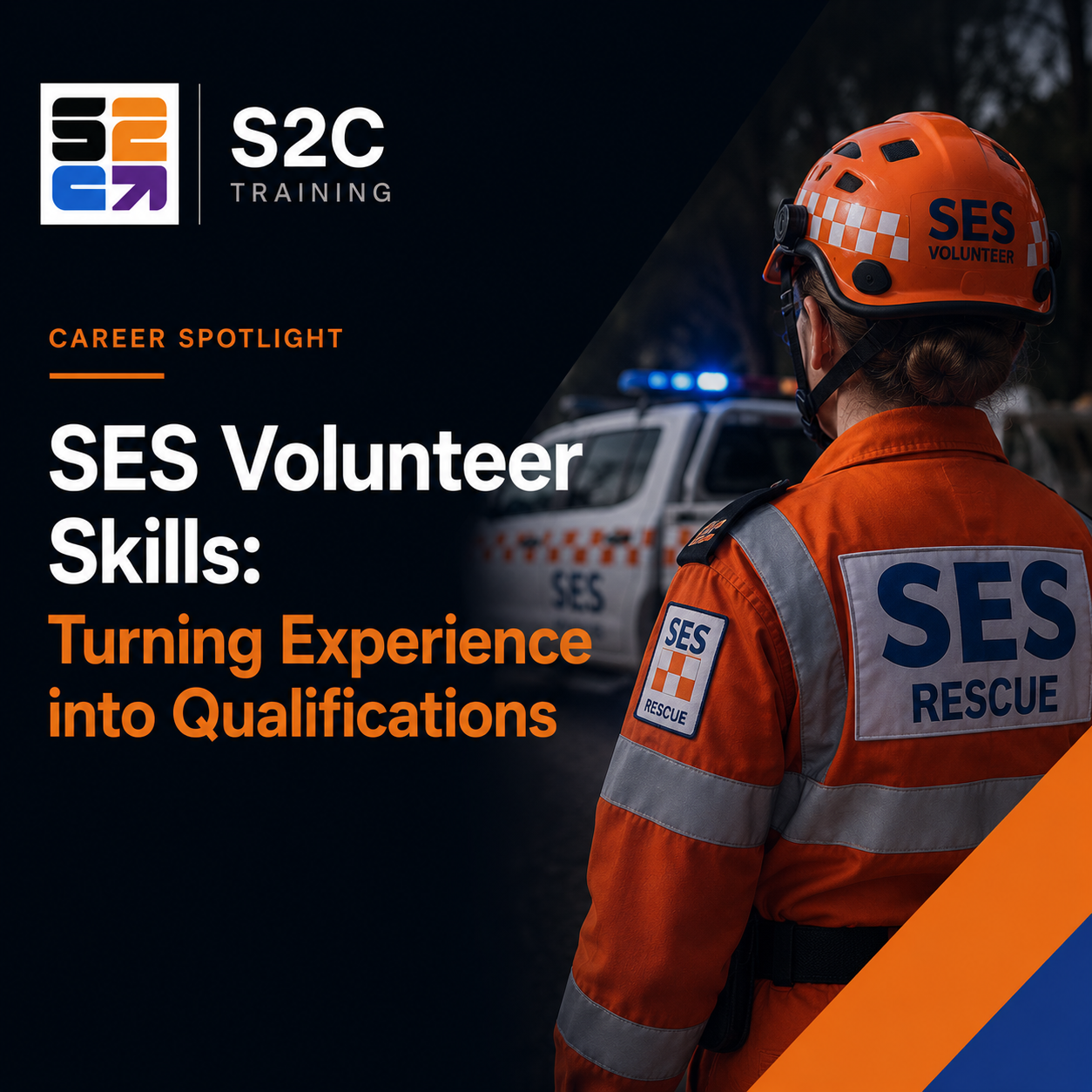
SES Volunteer Skills: Turning Experience into Qualifications
The quick answer
State Emergency Service (SES) members, most of them volunteers, respond to floods, storms and rescues, and in doing so build genuine, workplace-relevant skills in teamwork, safety, incident coordination and leadership. Those skills don't stop counting because they were earned as a volunteer. Through Recognition of Prior Learning (RPL), SES experience can contribute towards nationally recognised qualifications, the same as paid frontline work.
Who it's for: SES volunteers and staff, and other emergency volunteers
Key message: Volunteer experience is real, assessable experience
Transferable strengths: Teamwork, safety, incident coordination, leadership
Fastest route to recognition: RPL against nationally recognised qualifications
Does volunteer experience count towards qualifications?
Yes. This is the single most important point for SES members: Recognition of Prior Learning assesses your skills and knowledge regardless of whether you were paid for them. Volunteering with the SES builds exactly the kind of evidence RPL looks for, coordinating teams during callouts, following and running incident procedures, working safely in hazardous conditions, and leading or mentoring other volunteers.
Australia's emergency-services sector depends heavily on volunteers, and sustaining that workforce is a recognised national priority. Public Skills Australia, the Jobs and Skills Council for Public Safety, works with the sector on volunteer capability and leadership, including non-operational leadership roles (Public Skills Australia). Getting your SES experience formally recognised is one way that contribution can also advance your own career.
What skills do SES members build?
• Teamwork under pressure - coordinated response in demanding, unpredictable conditions.
• Safety and risk awareness - operating safely around hazards is fundamental to every callout.
• Incident coordination - planning, resourcing and running a response.
• Leadership and mentoring - many volunteers lead crews and train newer members.
Where do SES skills translate?
SES capability maps naturally onto leadership and management, work health and safety, project and logistics coordination, and business and operations roles. For members who volunteer alongside other work, RPL can also help formalise a career direction, or open a new one.
How Recognition of Prior Learning works for SES members
An assessor reviews evidence of what you do in the SES, callout records, leadership of crews, safety practices, coordination and planning, and maps it against a nationally recognised qualification. Where it meets the standard, it counts. Combined with any paid work experience, volunteer capability can add up to a full qualification faster than many people expect.
Related guides: Recognition of Prior Learning for Emergency Services Personnel · What Evidence Do I Need for RPL? · Can I Get a Qualification Based on Work Experience?
Which S2C qualifications map to SES experience?
S2C Training (RTO 45605) turns real experience, paid or volunteer, into nationally recognised qualifications through blended delivery and workplace-based assessment. For SES members, the natural fits are:
• Certificate IV in Leadership and Management - for crew leadership and coordination.
• Certificate IV in Work Health and Safety - for the safety and risk awareness central to SES work.
• Certificate IV in Project Management Practice and Certificate III in Supply Chain Operations - for the coordination and logistics behind emergency response.
Pathway example: from SES volunteer to safety coordinator
"Alex" volunteered with the SES for years while working in a warehouse, leading crews on storm and flood callouts and always the one focused on doing it safely. Combining that volunteer leadership with work experience, Alex used S2C's Certificate IV in Work Health and Safety via RPL to gain a nationally recognised qualification, and moved into a safety coordinator role, proving that volunteer experience genuinely counts.
Where to from here
Your SES service has built real, recognised-worthy skills. Whether you volunteer alongside a job or want to turn that experience into a new direction, the fastest step is to get it assessed.
Book a free skills check with S2C Training to see how your SES experience maps to a nationally recognised qualification.
Frequently asked questions
Does SES volunteer experience count towards a qualification?
Yes. Recognition of Prior Learning (RPL) assesses your skills and knowledge regardless of whether they were gained in paid or volunteer work. SES experience, coordinating callouts, working safely around hazards, and leading crews, can contribute towards nationally recognised qualifications.
What qualifications can SES volunteers get?
SES experience maps well to nationally recognised qualifications in leadership and management, work health and safety, and project or logistics coordination. Combined with any paid work experience, volunteer capability can often build towards a full qualification through RPL.
Can I use volunteering to change careers?
Yes. For many people, volunteer experience with the SES demonstrates leadership, safety and coordination skills that employers value. Formalising that experience through RPL can support a career change or open a new direction, alongside or instead of existing work.
More to explore
Keep reading to find insights that matter to your growth
How to Choose an RPL Provider: 7 Questions to Ask | S2C Training
The quick answer
Recognition of Prior Learning (RPL) is a regulated assessment process, but providers differ widely in how they deliver it. Before you enrol, check seven things: whether the provider is the Registered Training Organisation (RTO) that issues the qualification, whether the qualification is nationally recognised and on the provider's scope, what the assessment process involves, who the assessors are, what the fees and payment terms are, how long the process realistically takes, and what happens if your evidence does not cover everything. You can verify any provider and qualification on training.gov.au, the national register.
Choosing well matters. The right provider makes the process straightforward and the outcome credible. The wrong one costs you time, money and sometimes a qualification that does not hold up to scrutiny. Here are the seven questions worth asking, and why each one matters.
1. Are you the RTO that will issue my qualification?
Only a Registered Training Organisation can assess RPL and issue a nationally recognised qualification. Some businesses that advertise RPL services are not RTOs themselves; they operate under arrangements with a separate RTO that carries out the assessment and issues the certificate. That model is legal and regulated, but you should know who actually holds responsibility for your assessment, your records and your certificate before you pay anyone.
Ask for the RTO's registration number and look it up on training.gov.au, the Australian Government's national register. The listing shows the RTO's registration status and every qualification it is approved to deliver. S2C Training is a Registered Training Organisation in its own right, RTO 45605, which means we assess your evidence and we issue your qualification. One organisation, accountable end to end.
2. Is the qualification nationally recognised and on your scope?
A qualification only carries weight if it sits within the Australian Qualifications Framework (AQF) and appears on the issuing RTO's scope of registration. Scope matters: an RTO can only issue qualifications it is registered to deliver, and qualification codes are updated over time as training packages change.
When a provider quotes a qualification, check two things on training.gov.au: that the qualification code is current rather than superseded, and that it appears on that RTO's scope. If a provider offers a qualification that has been superseded, ask why.
3. What does the RPL process actually involve?
RPL is an assessment, not a paperwork formality. A credible provider will explain how your skills, knowledge and experience are assessed against the requirements of the qualification, what kinds of evidence you will need to provide, and how an assessor makes their decision. Evidence typically includes things like position descriptions, work samples, service or employment records, references and prior certificates, and a competency conversation with an assessor is common.
Be cautious of any provider that suggests the outcome is guaranteed, that no real evidence is needed, or that a qualification can simply be purchased. Under the Standards for RTOs, assessment decisions must be based on evidence of competency. A provider promising a certificate regardless of evidence is a warning sign, and a qualification issued that way may not survive an audit or an employer's scrutiny.
4. Who will assess my evidence, and do they understand my background?
Assessment quality depends on the assessor's ability to read your experience accurately. This matters most when your evidence does not look like a standard civilian CV. Service records, rank and posting histories, operational documents and emergency services experience all need an assessor who knows what they are looking at.
Ask who conducts the assessments and what experience they have with backgrounds like yours. At S2C Training we specialise in veterans, ex-services and ex-emergency-services students, and we have ex-serving members on our team, so your evidence is read by people who understand the environment it came from.
5. What are the fees, and what am I asked to pay upfront?
You should be able to get a clear, itemised picture of the total cost before you commit, including what the fee covers, what payment options exist and what the refund arrangements are. Australian consumer protections in vocational education also limit how much an RTO can collect from an individual student before services are delivered, so be wary of any provider asking for the full fee of a large enrolment upfront.
Ask for the provider's fee schedule and refund policy in writing. A provider that is transparent about money before enrolment is usually transparent everywhere else.
6. How long will it realistically take?
Timeframes vary with the qualification, the quality of your evidence and how quickly you can supply anything that is missing. A provider should give you a realistic range rather than a flat promise, because an honest answer depends on your circumstances. At S2C Training, RPL assessments typically take between 14 and 28 days once your evidence is in, though individual timeframes depend on the qualification and the completeness of your evidence.
Very fast promises deserve the same scrutiny as very cheap ones. Assessment takes the time it takes to be done properly.
7. What happens if my evidence does not cover everything?
RPL does not always result in a full qualification, and a good provider is upfront about that. Ask what happens if gaps are identified: whether partial recognition is available through a statement of attainment for the units you have demonstrated, whether gap training is offered to complete the remaining units, and what the costs of those options are.
A provider that explains the gap scenario before you enrol is showing you how they handle assessment honestly. One that never mentions the possibility is worth questioning.
A quick checklist before you commit
Looked the RTO up on training.gov.au and confirmed its registration and scope
Confirmed the qualification code is current, not superseded
Received a clear explanation of the evidence and assessment process
Asked who the assessors are and whether they understand your background
Received the fee schedule and refund policy in writing
Been given a realistic timeframe, not a guarantee
Understood the options if gaps are identified
Frequently asked questions
How do I check if an RPL provider is legitimate?
Search the provider's RTO number on training.gov.au, the Australian Government's national register. It shows whether the RTO's registration is current and which qualifications it is approved to deliver. If the business advertising RPL is not listed, ask which RTO will actually assess your evidence and issue your qualification.
Is a qualification gained through RPL the same as one gained through study?
Yes. RPL is a recognised assessment pathway under the Australian Qualifications Framework, and the qualification issued is the same nationally recognised qualification regardless of the pathway. What differs is how competency is demonstrated: through evidence of existing skills and experience rather than through coursework.
Can an RPL provider guarantee I will get the qualification?
No. An RPL outcome depends on an assessment of your evidence against the qualification's requirements. Any provider guaranteeing an outcome before seeing your evidence is a warning sign.
What is a scope of registration?
An RTO's scope of registration is the list of qualifications and units it is approved by the regulator to deliver and assess. It is public and searchable on training.gov.au. An RTO cannot issue a qualification outside its scope.
Does S2C Training offer RPL?
Yes. S2C Training (RTO 45605) offers RPL pathways across our nationally recognised qualifications, with a free, obligation-free Skills Check as the first step. We specialise in veterans, ex-services and ex-emergency-services students, and our team includes ex-serving members.
Start with a Skills Check
If you are weighing up RPL, our obligation-free Skills Check is a practical way to test the fit before committing to anything. We will map your experience against nationally recognised qualification options and give you clear guidance on your pathway. Call (07) 3555 7703 or email info@s2c.edu.au.

CTT Funding for RPL | Defence Transition Training Explained | S2C Training
DFTP and CTT Explained: Using Defence Transition Funding for Skills Recognition
The quick answer
Career Transition Training (CTT) is part of the Defence Force Transition Program (DFTP). It can contribute up to $5,320 towards approved education and training that supports your post-service employment goals, and this can include Recognition of Prior Learning (RPL) with a Registered Training Organisation. You can apply while still serving or for up to 24 months after separation, and access is arranged through your ADF Transition Coach. Approval is determined by Defence, not by training providers.
If you are planning your transition, understanding this funding before you separate can make a significant difference to what your next step costs you.
What is the Defence Force Transition Program?
The Defence Force Transition Program (DFTP) is the Department of Defence program that supports permanent and reserve ADF members through the move to civilian life. Every member transitions through a Transition Centre, where a Transition Support officer or Transition Coach works with you to build a personalised transition plan.
DFTP covers a range of supports, including coaching, transition seminars and approved absence for transition activities such as job interviews. The element most relevant to skills recognition is Career Transition Training.
What is Career Transition Training (CTT)?
CTT is a financial contribution of up to $5,320 towards training and upskilling that supports your employment or meaningful engagement goals after service. Where your Transition Coach identifies a training need, CTT can fund education and training delivered by providers such as Registered Training Organisations. Limited support may also be available for travel to attend training.
Three points matter here:
• The funding is capped. Any training costs above the approved amount are your responsibility, so it pays to choose a pathway where the funding goes furthest.
• Access runs through your Transition Coach. CTT is requested in consultation with your coach, currently via web form AC853-3, and approval sits with Defence. No training provider can approve or guarantee CTT funding, including us.
• The window extends past separation. You can apply while serving or for up to 24 months after leaving the ADF. If you are medically separating and cannot undertake training at the time, you may apply to preserve the benefit for later.
Can CTT funding be used for RPL?
Yes, where it is approved as part of your transition plan. Recognition of Prior Learning is an assessment pathway offered by Registered Training Organisations, and it is a form of vocational education and training activity that CTT funding can be directed towards when your Transition Coach identifies it as supporting your employment goals.
For many ADF members, RPL is a strong fit for transition funding because it is typically faster and lower-cost than completing a full course, which means the funding contribution stretches further. Rather than paying to be retrained in skills you built during your service, RPL assesses the evidence of what you already do, such as your service record, course reports, position descriptions and workplace documents, against the requirements of a nationally recognised qualification.
Important: eligibility for a qualification through RPL always depends on an individual assessment of your evidence. Neither CTT approval nor an RPL application guarantees a qualification outcome.
How do I apply for CTT funding?
The process runs through Defence, and it starts earlier than most people expect:
Engage your Transition Centre. All members transition through a Transition Centre, so make contact as soon as transition is on your horizon.
Work with your Transition Coach. Your coach helps identify your post-service employment goals and whether a training need supports them. Come to this conversation with a clear career direction, because applications are assessed against your stated goals.
Identify the training or RPL pathway. This is where a quote or proposal from your chosen provider comes in. If you are considering skills recognition, our obligation-free Skills Check can identify which nationally recognised qualifications your service experience may align with, which gives your coach something concrete to assess.
Submit the request. Your coach lodges the CTT request through the Defence process. Approval must be in place before you commit, as retrospective approval is generally not available.
What should I ask before choosing a provider?
Whichever provider you consider, and whatever funding you use, it is worth checking:
Is the provider the Registered Training Organisation that will issue the qualification, and what is its RTO number? You can check any RTO on training.gov.au. S2C Training is RTO 45605.
Does the provider have experience assessing Defence evidence such as service records, course reports and PMKeyS documents?
Is the qualification nationally recognised, and does it match the direction stated in your transition plan?
Is pricing clear enough to support a funding application?
Where S2C Training fits
S2C Training is a Registered Training Organisation (RTO 45605) built around veterans, ex-services and ex-emergency-services students, with ex-serving members on our team. We offer RPL pathways across our nationally recognised qualifications, and our free Skills Check is a practical first step before you speak with your Transition Coach: it maps your service experience against qualification and training options, so your CTT conversation starts with specifics rather than guesswork.
S2C Training is not affiliated with the Department of Defence, and we cannot approve, guarantee or advise on CTT funding decisions. Your Transition Coach and Transition Centre are the right contacts for funding eligibility.
Frequently asked questions
How much CTT funding can I access?
CTT can contribute up to $5,320 towards approved training. Costs above the approved amount are your own responsibility, and the figure is set by Defence and subject to change, so confirm the current amount with your Transition Centre.
Can I use CTT after I have already left the ADF?
Yes. You can apply for up to 24 months after separation. If you are medically separating and unable to train at the time, ask your Transition Coach about preserving the benefit.
Does CTT funding guarantee I will receive a qualification through RPL?
No. CTT is a funding contribution, and RPL is a separate assessment process. A qualification is only issued where your evidence demonstrates competency against the qualification's requirements.
Who approves CTT funding?
Defence, through your ADF Transition Coach and the Transition Centre process. Training providers, including S2C Training, have no role in the approval decision.
What if my training costs more than the CTT contribution?
You are responsible for the difference. This is one reason RPL is often a practical use of transition funding, as assessment-only pathways generally cost less than full course delivery.
Ready to see what your service adds up to?
Complete our obligation-free Skills Check and we will map your experience against nationally recognised qualification options, giving you a concrete pathway to discuss with your Transition Coach. Call (07) 3555 7703 or email info@s2c.edu.au.

AFP to Civilian Careers: Recognising Federal Policing Skills
The quick answer
The Australian Federal Police (AFP) is Australia's national policing agency, tackling everything from serious and organised crime to national security, cybercrime, aviation and close protection. It is a substantial, specialised workforce: the AFP reported 8,328 staff as at 30 June 2025, across sworn police officers, protective service officers and specialist professional staff (AFP Annual Report 2024-25), working in over 200 role types. For officers and staff formalising their capability or planning a civilian move, Recognition of Prior Learning (RPL) turns AFP experience into nationally recognised qualifications.
Workforce: 8,328 staff (AFP, at 30 June 2025)
Breadth: 200+ role types - sworn, protective service and specialist
Transferable strengths: Investigation, intelligence, leadership, risk, coordination
Fastest route to recognition: RPL against nationally recognised qualifications
How is the AFP different from state police?
While state and territory police handle community policing within their jurisdiction, the AFP is the national agency, responsible for enforcing Commonwealth law and protecting national interests. Its work spans serious and organised crime, counter-terrorism and national security, cybercrime, fraud, aviation policing, and the protection of people and places. That breadth means AFP experience often carries a strong specialist and intelligence dimension on top of core policing skills.
What skills do AFP officers and staff build?
Federal policing builds a deep, transferable skill set: complex investigation, intelligence gathering and analysis, risk and threat assessment, operational and team leadership, stakeholder coordination across agencies and borders, and disciplined decision-making. The AFP's substantial cohort of specialist and professional staff, in areas like forensics, cyber, intelligence and corporate functions, adds technical and analytical depth alongside operational capability.
These are exactly the competencies civilian employers seek for leadership, investigations, compliance, risk, security and analytical roles, particularly in sectors where integrity and rigour matter.
Where do AFP skills translate?
• Leadership and operations management - coordinating teams and complex operations.
• Investigations and compliance - evidence, analysis and rigorous decision-making.
• Risk, security and intelligence - assessing and managing threats in the private and public sectors.
• Project and program coordination - planning and delivering complex, multi-stakeholder work.
How Recognition of Prior Learning works for AFP members
RPL credits the leadership, investigation and coordination experience you already hold against a nationally recognised qualification. Evidence like documented investigations, team and operational leadership, risk assessments and program coordination maps directly to qualification units, so experienced members can be recognised for capability they use daily.
Related guides: Recognition of Prior Learning for Emergency Services Personnel · Can I Get a Qualification Based on Work Experience? · Recognition of Prior Learning vs Credit Transfer
Which S2C qualifications map to AFP experience?
S2C Training (RTO 45605) turns service experience into nationally recognised qualifications through blended delivery and workplace-based assessment. For AFP officers and staff, the natural fits are:
• Certificate IV in Leadership and Management and the Advanced Diploma of Leadership and Management - for the operational and team leadership federal policing builds.
• Certificate IV in Project Management Practice and the Diploma of Project Management - for coordinating complex, multi-stakeholder operations.
• Certificate IV in Work Health and Safety - for the risk and safety expertise built in operational roles.
• Certificate IV in Business - for broad operational and administrative capability, including for professional staff.
Pathway example: from AFP investigator to risk manager
"Chris" spent over a decade with the AFP in investigations and intelligence, leading teams on complex, multi-agency operations. Planning a move into corporate risk, Chris used S2C's Advanced Diploma of Leadership and Management via RPL to formalise years of operational leadership into a nationally recognised qualification, giving employers a clear signal of the capability behind the service record.
Where to from here
Federal policing builds leadership, investigation and analytical skills that civilian employers actively seek. Whether you're progressing, transitioning, or planning ahead, the fastest step is to get your skills formally recognised.
Complete a free skills check with S2C Training to see how your AFP experience maps to a nationally recognised qualification.
Frequently asked questions
What is the difference between the AFP and state police?
State and territory police handle community policing within their jurisdiction, while the Australian Federal Police is the national agency enforcing Commonwealth law. The AFP covers serious and organised crime, national security, cybercrime, aviation policing and protection, often with a strong specialist and intelligence dimension.
How many people work for the AFP?
The Australian Federal Police reported 8,328 staff as at 30 June 2025, comprising sworn police officers, protective service officers and specialist professional staff across more than 200 role types, located across Australia and overseas.
What civilian jobs suit former AFP officers?
AFP experience translates strongly into leadership and operations management, investigations and compliance, risk, security and intelligence roles, and project or program coordination, particularly in sectors where integrity and analytical rigour are valued.
Can AFP staff get civilian qualifications through RPL?
Yes. Through Recognition of Prior Learning (RPL), AFP officers and professional staff can have their leadership, investigation, intelligence and coordination experience assessed against nationally recognised qualifications, without repeating training they already apply at work.
Start your Qualification Journey Today. Obligation Free.
No guesswork. A clear, supported pathway to recognising your experience - with training only where it's needed.
.png)